
Search
Remove Ads
Advertisement
Search Results

Article
Twelve Famous Women of the Middle Ages
Women in the Middle Ages were frequently characterized as second-class citizens by the Church and the patriarchal aristocracy. Women's status was somewhat elevated in the High and Late Middle Ages by the cult...

Article
Mongol Multiculturalism
The Mongol Empire accepted and promoted many other cultures. Historians often talk about cultural exchange across Asia in the Mongol Empire as something that was just facilitated by peace and stability across such a huge...

Article
Clocks in the Scientific Revolution
Keeping good time proved an elusive objective for centuries, and it was only in the second half of the 17th century, during the Scientific Revolution (1500-1700), that clocks were made which lost seconds rather...

Article
Sources of History
History (from the Greek ἱστορία, meaning 'a learning or knowing by inquiry') can be broadly taken to indicate the past in general but is usually defined as the study of the past from the point at which there were written sources...

Article
William Harvey's Discovery of Blood Circulation
The human body's system of blood circulation was discovered by the English physician and anatomist William Harvey (1578-1657) in 1628. Harvey determined the relationship between the blood system of arteries...

Article
Thucydides on the Plague of Athens: Text & Commentary
The Plague of Athens (429-426 BCE) struck the city, most likely, in 430 BCE before it was recognized as an epidemic and, before it was done, had claimed between 75,000-100,000 lives. Modern-day scholars...

Article
The Thermometer & the Scientific Revolution
The thermometer was invented in the mid-17th century during the Scientific Revolution when scientists began to search for an accurate instrument to measure a wide range of temperatures using a scale that...
Article
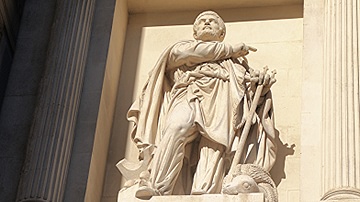
On the Ocean: The Famous Voyage of Pytheas
Sometime around 330 BCE, Pytheas, a little-known Greek merchant, embarked on an astonishing voyage. It was a voyage that would take him far beyond the known boundaries of the Mediterranean, into lands thought...

Article
Women in the Byzantine Empire
Women in the Byzantine Empire (4th to 15th century CE) were, amongst the upper classes, largely expected to supervise the family home and raise children while those who had to work for a living did so in most of the...

Article
A Brief History of Genetics - How Genetics Transformed Medicine and Identity
Genetics is the study of how genes are transmitted across generations, which includes the genetic information that produces an individual's traits, physical characteristics, and...
