
Search
Remove Ads
Advertisement
Search Results

Definition
Roman Science
The Romans assimilated earlier Greek science for their own purposes, evaluating and then accepting or rejecting that which was most useful, much as they did in other fields such as warfare, art, and theatre. This assimilation of...

Definition
Mithridates VI
Mithridates VI (120-63 BCE, also known as Mithradates, Mithradates Eupator Dionysius, Mithridates the Great) was the king of Pontus (modern-day northeastern Turkey) who was regarded by his people as their savior from the oppression...

Definition
Early Joseon Period
The Early Joseon Period (1392 - c. 1550 CE) in Korea was bookended by internal power struggles but witnessed major scientific and societal advances and prosperity. The Joseon (Choson) Dynasty ruled Korea from 1392 CE to 1897...

Definition
Boer War - Imperialism v. Nationalism in Southern Africa
The Boer War (aka Second Anglo-Boer War, South Africa War, and Second War of Freedom, 1899-1902) was won by the British but only after it employed controversial policies such as scorched-earth tactics...

Definition
Homo Rudolfensis
Homo rudolfensis is an early human species that lived in East Africa between c. 2.5 and 1.8 million years ago. It is known from a handful of skull, jaw and teeth fragments that remind alternatingly of Homo or of Australopithecus...

Definition
Leo Africanus
Leo Africanus (al-Hasan ibn Muhammad ibn Ahmad al-Wazzan al-Fasi al-Granati, 1485-1554) was a diplomat, merchant traveller and scholar who famously voyaged from Timbuktu to the Niger River and wrote 'The Description of Africa' (La...

Definition
Gottfried Wilhelm Leibniz
Gottfried Wilhelm Leibniz (1646-1716) was a German polymath who became well-known across Europe for his work, particularly in the fields of science, mathematics, and philosophy. Leibniz's rationalist philosophy attempted...
Definition
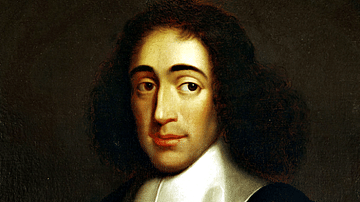
Baruch Spinoza
Baruch Spinoza (1632-1677) was a Dutch philosopher who combined rationalism and metaphysics to create a unique system of thought. Spinoza was held up as an atheist philosopher in the 18th century, but this is not an entirely accurate...

Definition
Marcello Malpighi
Marcello Malpighi (1628-1694) was an Italian scientist and physician famous for discovering the capillaries of the human circulatory system in 1661 and, as the greatest anatomist of the Scientific Revolution, founding the science...

Definition
Battle of Valmy
The Battle of Valmy was a stunning French victory over a Prussian-led coalition army on 20 September 1792, during the French Revolutionary Wars (1792-1802). Although the battle was little more than a skirmish, it halted the coalition's...
