
Search
Remove Ads
Advertisement
Search Results

Definition
Marquis de Condorcet
Marie Jean Antoine Nicolas de Caritat, Marquis de Condorcet (1743-1794), also known as Nicolas de Condorcet, was a French philosopher, political theorist, and mathematician. His ideas, encompassing a wide range of topics from...
Article
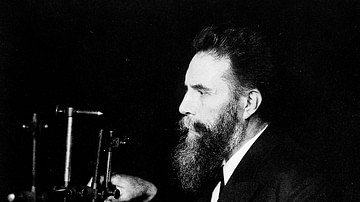
Discovery of X-Rays
The discovery of X-rays – a form of invisible radiation that can pass through objects, including human tissue – revolutionised science and medicine in the late 19th century. Wilhelm Conrad Röntgen (1845-1923), a German scientist...

Image
Portrait of Blaise Pascal
An engraved portrait of the French mathematician, scientist, and philosopher Blaise Pascal (1623-1662). Engraved by Ambroise Tardieu (1788-1841). (Science Museum, London)

Definition
Scientific Revolution
The Scientific Revolution (1500-1700), which occurred first in Europe before spreading worldwide, witnessed a new approach to knowledge gathering – the scientific method – which utilised new technologies like the telescope...

Definition
Thomas Hobbes
Thomas Hobbes (1588-1679) was an English philosopher who famously summarised his pessimistic view of human nature in his greatest work, Leviathan, published in 1651. Hobbes believed that the life of humanity in the state of nature...

Definition
Manhattan Project - How the Atomic Bomb Was Built
The Manhattan Project was the code name for the secret US-led programme to develop an atomic bomb during the Second World War (1939-45). Hugely expensive and employing the best scientific minds from Europe...

Definition
Francis Bacon
Francis Bacon (1561-1626) was an English philosopher, statesman, and author. Bacon is often considered one of the founders of modern scientific research and scientific method, even as "the father of modern science" since he proposed...

Definition
Tycho Brahe
Tycho Brahe (1546-1601) was a Danish nobleman who made the most significant contribution to our knowledge of astronomy before the telescope arrived. He discovered a supernova, observed the elliptical interplanetary orbit of a comet...
Definition
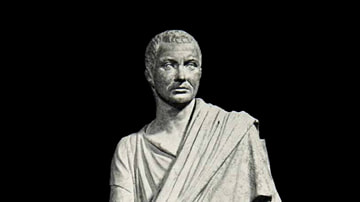
Marcus Claudius Marcellus
Marcus Claudius Marcellus (c. 270-208 BCE) was a five-time consul and, earning the nickname the 'Sword of Rome', he was one of the city's greatest military commanders. Active in both the First and Second Punic Wars, he...

Article
6 Key Instruments of the Scientific Revolution
The Scientific Revolution (1500-1700) was driven by several key inventions, all scientific instruments that became essential to achieving a greater understanding of the world around us. With instruments...
