
Search
Did you mean: Wall?
Remove Ads
Advertisement
Search Results

Definition
Vortigern
Vortigern was a 5th-century British ruler best known for inviting the Saxons to Britain to stop the incursions of the Picts and Scots and allowing them to take control of the land. 'Vortigern' is a title, not a given name, and means...

Definition
Namazu
Namazu (aka Onamazu) is the giant catfish of Japanese mythology held responsible for creating earthquakes. The creature was thought to live under the earth, and when it swam through the underwater seas and rivers there, it caused earthquakes...
Definition
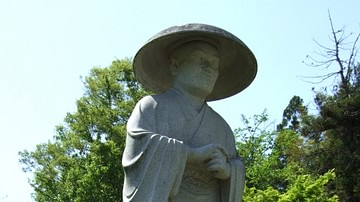
Ennin
Ennin (c. 793-864 CE, posthumous title: Jikaku Daishi) was a Japanese Buddhist monk of the Tendai sect who studied Buddhism at length in China and brought back knowledge of esoteric rituals, sutras, and relics. On his return, he published...

Definition
Pi-Ramesses
Pi-Ramesses (also known as Per-Ramesses, Piramese, Pr-Rameses, Pir-Ramaseu) was the city built as the new capital in the Delta region of ancient Egypt by Ramesses II (known as The Great, 1279-1213 BCE). It was located at the site...

Definition
Amarna Period of Egypt
The Amarna Period of ancient Egypt was the era of the reign of Akhenaten (1353-1336 BCE), known as 'the heretic king'. In the 5th year of his reign (c. 1348 BCE), he issued sweeping religious reforms which resulted in the...

Definition
Pausanias (Geographer)
Pausanias was a Greek author, historian, and geographer of the 2nd century CE who journeyed extensively throughout Greece, chronicling these travels in his Periegesis Hellados or Description of Greece. His ten volumes of...

Definition
Ancient Egyptian Vizier
The vizier in ancient Egypt was the most powerful position after that of king. Known as the djat, tjat, or tjati in ancient Egyptian, a vizier was the equivalent of the modern-day prime minister of the nation who actually...

Definition
Jurchen Jin Dynasty
The Jurchen Jin dynasty (meaning “Golden”) ruled parts of China, Mongolia, and northern Korea from 1115 to 1234 CE. The Jurchen originated from Manchuria, but in conquering the neighbouring Liao empire of the Khitan and parts...

Definition
Byzantine Coinage
The coinage of the Byzantine Empire continued that of its more ancient predecessors and functioned as a convenient method of payment for goods and services, especially to soldiers and officials, and as a means for people to pay...

Definition
Constantine VII
Constantine VII was Byzantine emperor from 945 until 959 CE. Sometimes known as Constantine Porphyrogennetos because of his birth in the purple chamber of the royal palace, he was served by various regents from 912 CE until reigning...
