
Search
Did you mean: Wall?
Remove Ads
Advertisement
Search Results
Definition
Persephone
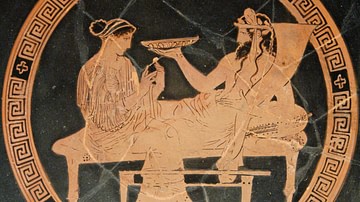
Persephone (aka Kore) was the Greek goddess of agriculture and vegetation, especially grain, and the wife of Hades, the ruler of the Underworld. Persephone was an important element of the Eleusinian Mysteries and the Thesmophoria...
Definition
Uranus
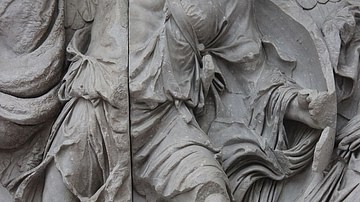
Uranus (also spelt Ouranos) is the personification of heaven and the sky in Greek mythology. His Roman counterpart is Caelus. Gaia (Earth) gave birth to Uranus and chose him to be her equal. She lay with him, resulting in the birth of...
Definition
Oxus
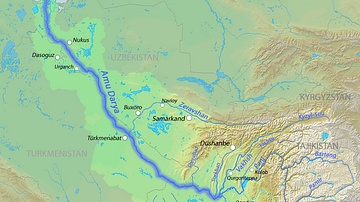
The Oxus is a river, today called Amu Darya in its western part and Wakhsh in its eastern parts, which flows for a length of 2400 km across modern Tajikistan, Afghanistan, Turkmenistan and Uzbekistan into Lake Aral. In Ancient times it...

Definition
Bucchero
Bucchero wares are a shiny dark grey to black pottery produced by the Etruscans of central Italy from the 7th to 4th century BCE. Used for everyday purposes and as funerary and votive objects, bucchero incorporates many forms from simple...

Definition
Bes
Bes is the ancient Egyptian god of childbirth, fertility, sexuality, humor, and war, but served primarily as a protector god of pregnant women and children. He is regularly depicted as a dwarf with large ears, long-haired and bearded, with...

Definition
Hyksos - The Rulers of Foreign Lands Who Transformed Egypt
The Hyksos were a West Semitic-speaking people who gained a foothold in Egypt circa 1782 BCE at the city of Avaris in Lower Egypt, thus initiating the era known in Egyptian history as the Second...

Definition
Hellenistic Period
The Hellenistic Period is a part of the Ancient Period for the European and Near Asian space. The use of this period is justified by the extent of the Hellenic culture in most of these areas, due to the Greek political presence...

Definition
Ptolemy XIII Theos Philopator
Ptolemy XIII Theos Philopator (The Father-loving God, born 62/61 BCE, died 47 BCE) was pharaoh of Egypt from 51 BCE until his death. His reign began as co-ruler with his sister, the famous Cleopatra VII, following the...

Definition
Spartacus
Throughout history - both ancient and modern - those bound in chains have fought to free themselves from their oppressors. As with most civilizations - Assyrian, Greek and even American - slaves in ancient Rome were not considered...
Definition
Homo Sapiens
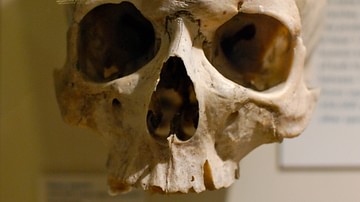
Homo sapiens ('wise man'), or modern humans, are the only species of human still around today. Despite having invented countless ways of labelling the world around us, we have so far done a surprisingly poor job at defining ourselves...
