
Search
Remove Ads
Advertisement
Search Results

Article
Exploring Roman Morocco
Morocco, then known as Mauretania, was annexed by the Roman Empire in 40 CE. The Romans in Morocco left a vast legacy with archaeological sites that dot the country's northern landscape, especially Volubilis, with its vestiges...

Definition
Roman Siege Warfare
In ancient warfare open battles were the preferred mode of meeting the enemy, but sometimes, when defenders took a stand within their well-fortified city or military camp, siege warfare became a necessity, despite its high...

Definition
Mauretania
Mauretania was an ancient kingdom in northwest Africa, encompassing regions of modern-day Morocco and Algeria. Although it shares a name with the modern country of Mauritania, they do not overlap. Ancient Mauretania was named after...

Image
Fresco with Theatre Mask and Peacock, Oplontis Villa Poppaea
Fresco in the Second Style showing a theatre mask, a peacock, and a perspective view of colonnades. The fresco decorates the east wall of the large oecus (room) of the Oplontis Villa Poppaea...

Definition
Athanaric
Athanaric (died c. 381 CE) was a king of the Thervingi Goths (better known as the Visigoths) and, according to some sources, the first and greatest king. He was of the noble Balts family of the Thervingi tribe and a relative of the...

Article
Caesarea Maritima's Role in the Roman Empire
Caesarea Maritima, the city Herod the Great (r. 37-4 BCE) built for Rome on the southeastern coast of the Mediterranean served as the Roman Empire's powerbase of operations both commercially and militarily...

Definition
Maximilian I, Holy Roman Emperor - The Great Matchmaker
Maximilian I, Holy Roman Emperor (1459-1519), belonged to the imperial House of Habsburg, and the imperial electors made him King of the Romans in 1486 during his father's lifetime, thus establishing...

Definition
Roman Gladiator
A Roman gladiator was an ancient professional fighter who usually specialised with particular weapons and types of armour. They fought before the public in hugely popular organised games held in large purpose-built arenas throughout...

Article
Fall of the Western Roman Empire
To many historians, the fall of the Western Roman Empire in the 5th century CE has always been viewed as the end of the ancient world and the onset of the Middle Ages, often improperly called the Dark Ages, despite...
Image
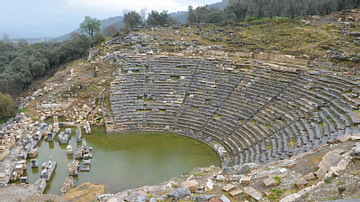
Theatre at Stratonicea
The theatre at Stratonicea, erected in the Hellenistic period in the north slope of the south hill, its capacity was approximately 10,000 spectators.
