
Search
Remove Ads
Advertisement
Search Results
Definition
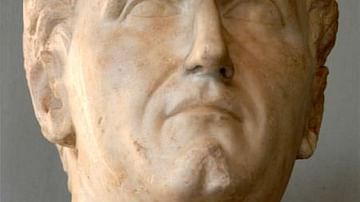
Nerva
Marcus Cocceius Nerva was Roman emperor from 96 to 98 CE, and his reign brought stability after the turbulent successions of his predecessors. In addition, Nerva helped establish the foundations for a new golden era for Rome which his...

Definition
Eustathios Rhomaios - Judge and Jurist of the Byzantine Empire
Eustathios Rhomaios was a prominent Byzantine judge and jurist during the late-10th and early- to mid-11th century. He studied Roman Law and began his career under Basil II (reign 976 to 1025...

Definition
Vercingetorix
Vercingetorix (82-46 BCE) was a Gallic chieftain who rallied the tribes of Gaul (modern-day France) to repel the Roman invasion of Julius Caesar in 52 BCE. His name means "Victor of a Hundred Battles" and was not his birth name...

Definition
Legio I Adiutrix
Legio I Adiutrix was a legion of the Roman army formed from veteran sailors after the death of Roman emperor Nero (r. 54-68 CE). During its long career, the legion accompanied Trajan (r. 98-117 CE) on his Dacian and Parthian campaigns...

Definition
Magnus Maximus
Magnus Maximus (c. 355 - August 28, 388 CE) was a Roman usurper and Western Roman Emperor from 383-388 CE. He was a prominent general in the Roman army, particularly in the province of Britain. In 383 CE he usurped the Western...

Article
Tacitus' Account of The Battle of Mons Graupius
The Battle of Mons Graupius was fought in 83 CE between the invading forces of Rome, under the general Agricola, and the Picts, the indigenous people of modern-day Scotland, under their leader Calgacus...

Image
The Roman-Parthian Conflict (53 BCE - 217 CE)
The Roman–Parthian conflict (53 BCE–217 CE) was a centuries-long struggle for dominance in Western Asia between the Roman Republic, later Empire, and the Arsacid dynasty of Parthia. It began with Rome’s...

Image
Map of Roman Hispania under Hadrian, c. 125 CE - Administration and Urban Networks in the Iberian Peninsula
Roman Hispania under Hadrian (reign 117–138 CE) represented the outcome of a long and often violent process of conquest, beginning during the Second Punic...

Image
Map of the Fall of the Western Roman Empire, c. 480 CE
The disintegration of the Western Roman Empire unfolded gradually during the Migration Period (c. 400–800 CE), as waves of migrating and invading peoples reshaped Europe. After the death of Theodosius...

Article
Love, Sex, & Marriage in Ancient Rome
Love, sex, and marriage in ancient Rome were defined by the patriarchy. The head of the household was the father (the pater familias) who had complete control over the lives of his wife, children, and slaves...
