
Search
Remove Ads
Advertisement
Search Results

Collection
Battles of the Roman Empire
The Roman Empire was forged through warfare and in this collection we look at some of the key battles and revolts that shaped its borders from the reign of Augustus onwards. We look at Varus' shocking defeat at the Battle...

Image
Roman Coin with Soldiers
A Roman coin depicting two standing soldiers. Denarius of Caius Servilius, 1st century BCE. (Archaeological Museum, Tarragona, Spain)

Image
Roman Statue of Anubis
A Roman marble statue of the Egyptian god Anubis. Provenance: Anzio, Villa Pamphili, 1st-2nd century CE. (Vatican Museums, Rome).

Definition
Consul
In 509 BCE, with the exit of the last Etruscan king, Lucius Tarquinius Superbus, the Roman people were presented with a unique opportunity, an opportunity that would eventually have an immense impact on the rest of Europe for centuries...

Article
Battle of Carrhae, 53 BCE
The Battle of Carrhae in 53 BCE was one of the greatest military catastrophes in all of Roman history when a hero of the Spartacus campaign, Marcus Licinius Crassus (115-53 BCE), initiated an unprovoked invasion of Parthian...

Article
Rome's Response to the Spread of Christianity
During the 1st century CE, a sect of Jews in Jerusalem claimed that their teacher, Jesus of Nazareth, was the 'messiah' of Israel. 'Messiah' meant 'anointed one', or someone chosen by the God of Israel...
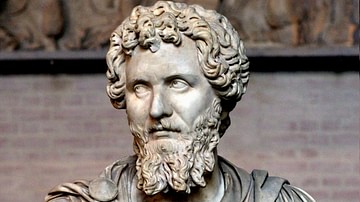
Definition
Septimius Severus
Lucius Septimius Severus was Roman emperor from April 193 to February 211 CE. He was of Libyan descent from Lepcis Magna and came from a locally prominent Punic family who had a history of rising to senatorial as well as consular...

Definition
Gaius Cassius Longinus - Liberator, Tyrannicide, or Traitor?
Gaius Cassius Longinus (circa 86-42 BCE) was a leader of the 'Liberators', the faction of Roman senators who assassinated Julius Caesar on the Ides of March (15 March) 44 BCE. Motivated by a...

Definition
Tiberius - The Reclusive Roman Emperor
Tiberius (42 BCE to 37 CE) was the second Roman emperor, who reigned from 14 to 37 CE. The adopted son of Augustus, he led a long and tormented life of service to the Roman Empire before becoming princeps (emperor...

Definition
Corpus Juris Civilis - The Justinian Law Code
The Justinian Code or Corpus Juris Civilis (Corpus of Civil Law) was a major reform of Byzantine law created by Emperor Justinian I (r. 527-565 CE) in 528-9 CE. Aiming to clarify and update the old Roman...
