
Search
Did you mean: Roman Mosaics?
Remove Ads
Advertisement
Search Results

Definition
Ambiorix
Ambiorix (c. 54/53 BCE) was the co-ruler of the Eburone tribe of Gallia Belgica (north-eastern Gaul, modern-day Belgium) who led an insurrection against Caesar's occupying forces in Gaul in the winter of 54/53 BCE. Nothing is known...

Definition
Galla Placidia
Galla Placidia (388-450 CE), the future empress, was the half-sister of the Westen Roman emperor Flavius Honorius (r. 395-423 CE), and the daughter of Theodosius the Great (r. 379-395 CE). She was taken hostage by Alaric during...

Definition
Caesarea Maritima
Caesarea Maritima was a city built over 2,000 years ago (c. 22-10 BCE) on the coast of the Eastern Mediterranean. With Roman engineering and largesse, Herod the Great (r. 37-4 BCE) accomplished this feat by constructing a whole...

Definition
Caracalla
Caracalla was Roman emperor from 211 to 217 CE. Born Lucius Septimius Bassianus, son of Septimius Severus and Julia Domna, he became co-ruler with his father in 198 CE and sole ruler after the death of his father in 211 CE and of his...
Article
The Spartacus Revolt
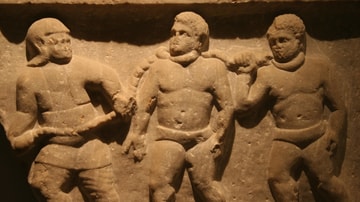
The revolt of the gladiator Spartacus in 73-71 BCE remains the most successful slave revolt in the history of Rome. The rebellion is known as the Third Servile War and was the last of three major slave revolts which Rome suppressed...

Definition
Gracchi Brothers
Tiberius Sempronius Gracchus (c. 163-133 BCE) and his younger brother Gaius (c. 154-121 BCE) were tribunes of the plebs in the Roman Republic. Serving in 133 BCE, Tiberius introduced a land reform but was beaten to death after...

Definition
Vespasian - The Commoner Who Became Roman Emperor
Vespasian (9-79 CE) was Roman emperor from 69 to 79 CE. Despite his low birth, he worked hard to rise through the ranks of Roman politics and eventually achieved prominence as a military commander. He...
Definition
Sallust
Gaius Sallustius Crispus (86-35 BCE), better known as Sallust, was a Roman statesman and historian. He turned away from an unsuccessful career in both politics and the Roman army, choosing instead on a writing career and produced three...

Definition
Byzantine Empire
The Byzantine Empire existed from 330 to 1453. It is often called the Eastern Roman Empire or simply Byzantium. The Byzantine capital was founded at Constantinople by Constantine I (r. 306-337). The Byzantine Empire varied in...
Image
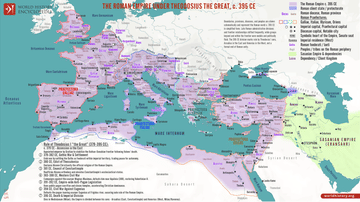
Map of the Roman Empire under Theodosius the Great, c.395 - The Last Unified Roman Empire
A map of the Roman Empire under Theodosius I “the Great” (reign 379–395 CE). His reign marked a decisive turning point in Roman imperial history, bringing together political...
