
Search
Did you mean: Roman Mosaics?
Remove Ads
Advertisement
Search Results

Definition
Celtic Warfare
The Celts were a linguistic group which spanned across a wide geographic area and included numerous cultures and ethnicities. Because of this fact, the traditions, practices, and lifestyles of Celtic-speaking peoples varied considerably...

Definition
Aqueduct
Aqueducts transport water from one place to another, achieving a regular and controlled supply to a place that would not otherwise receive sufficient quantities. Consequently, aqueducts met basic needs from antiquity onwards such as...
Definition
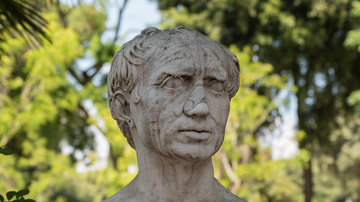
Gaius Marius
Gaius Marius (c. 157-86 BCE) was an accomplished military commander and politician who was acclaimed for saving Rome from the brink of collapse. Yet, unfortunately, his name has only survived in relative obscurity because his achievements...

Image
Map of the Diocletian's First Tetrarchy and the Roman Empire - Stability Through Division, Succession by Design
The First Tetrarchy (293–305 CE) was Emperor Diocletian's (reign 284–305 CE) solution to the political and military crises that had nearly destroyed the...

Image
The Seven Prince-Electors of the Holy Roman Empire - The Golden Bull and the Election of the King of the Romans
The Holy Roman Empire (962–1806) was a decentralized political order in which authority was shared among the monarch, territorial princes, ecclesiastical...

Article
Tacitus' Account of The Battle of Mons Graupius
The Battle of Mons Graupius was fought in 83 CE between the invading forces of Rome, under the general Agricola, and the Picts, the indigenous people of modern-day Scotland, under their leader Calgacus...

Definition
Ancient Rome
According to legend, Ancient Rome was founded by the two brothers, and demigods, Romulus and Remus, on 21 April 753 BCE. The legend claims that in an argument over who would rule the city (or, in another version, where the city would...

Definition
Diocletian
Diocletian was Roman emperor from 284 to 305 CE. After the defeat and death of the Roman emperor Philip the Arab in 249 CE, the empire endured over three decades of ineffective rulers. The glory days of Augustus, Vespasian, and Trajan...

Image
Map of the The Roman Empire under the Flavian Dynasty, c. 96 - Provinces, Frontiers, and Expansion after 69 CE
The Roman Empire at the close of the Flavian dynasty (69–96 CE) reflected a period of political recovery and administrative consolidation following the...

Image
Map of the Roman Trade with the East, c. 1st–3rd Centuries - Silk Roads and Indian Ocean Routes across Afro-Eurasia
Roman trade with the East refers to the overland and maritime exchange networks that connected the Roman Empire with Parthian Iran, the Kushan Empire...
