
Search
Did you mean: Roman Mosaics?
Remove Ads
Advertisement
Search Results

Image
The Baths of the Roman Empire - The Architecture of Daily Life
Public bathhouses (balnea and large imperial thermae) were a defining feature of urban life across the Roman Empire (27 BCE–476 CE in the West). Building on earlier bathing traditions in the...

Image
Organization of the Imperial Roman Army
The Imperial Roman Army formed the backbone of Roman power from the establishment of the Principate under Augustus (reign 27 BCE–14 CE) to the collapse of imperial authority in the West (c. 480 CE). More than...
Article
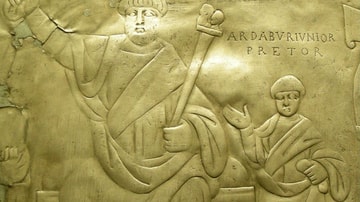
The Isaurians and the End of Germanic Influence in Byzantium
Germanic influence reigned in the Roman Empire from the end of the 4th century CE through the 5th. Germanic individuals took important posts in the government and the military, and Germanic...

Article
Rome under the Julio-Claudian Dynasty
The Julio-Claudians were the first dynasty to rule the Roman Empire. After the death of the dictator-for-life Julius Caesar in 44 BCE, his adopted son Octavian - later to become known as Augustus (r. 27 BCE -...

Definition
Commius
Commius was an Atrebates noble during Julius Caesar's Gallic Wars (58-50 BCE) who turned from Roman ally to indomitable foe. As king of the Atrebates, Commius ably served Caesar in Britannia and Gaul before becoming one of the main leaders...

Definition
Battle of Pydna
The Battle of Pydna in June 168 BCE was a decisive Roman victory that ended the Third Macedonian War and established Rome as the dominant power in the Mediterranean. The Roman Republic was expanding, enlarging its sphere of influence...

Definition
Ptolemaic Dynasty
The Ptolemaic dynasty was a Macedonian royal family that ruled Ptolemaic Egypt from 323 to 30 BCE. It was founded by Ptolemy I, a general and successor of Alexander the Great. They built Alexandria, including the Lighthouse of...

Definition
Dacia
Dacia was a region inhabited by the Dacians in the north of the Danube (modern Romania). The kingdom of Dacia was the creation of Burebistas (c. 80-44 BCE), who conquered and united several other Dacian principalities. Burebistas practically...

Definition
Brennus
Brennus (c. 390 BCE) was the Gallic war chief of the Senones who sacked and occupied Rome in 390 BCE. Nothing is known of him outside of the accounts given of this event which immortalized him as coining the phrase, “Woe to the Vanquished”...

Definition
Cleopatra VII - The Last Great Pharaoh of Ancient Egypt
Cleopatra VII (69-30 BCE, reign 51-30 BCE) was the last ruler of Egypt before it was annexed as a province of Rome. Arguably the most famous Egyptian queen, Cleopatra was ethnically Greek as a member...
