
Search
Remove Ads
Advertisement
Search Results

Definition
Tiberius - The Reclusive Roman Emperor
Tiberius (42 BCE to 37 CE) was the second Roman emperor, who reigned from 14 to 37 CE. The adopted son of Augustus, he led a long and tormented life of service to the Roman Empire before becoming princeps (emperor...

Definition
Gaius Cassius Longinus - Liberator, Tyrannicide, or Traitor?
Gaius Cassius Longinus (circa 86-42 BCE) was a leader of the 'Liberators', the faction of Roman senators who assassinated Julius Caesar on the Ides of March (15 March) 44 BCE. Motivated by a...

Definition
Praetor
A praetor was a senior magistrate in ancient Roman government, who was granted executive or imperium powers similar to that of the consuls. Although originally assigned legal authority over the courts, his executive powers allowed him...
Definition
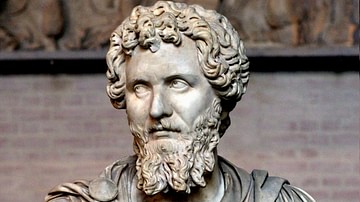
Septimius Severus
Lucius Septimius Severus was Roman emperor from April 193 to February 211 CE. He was of Libyan descent from Lepcis Magna and came from a locally prominent Punic family who had a history of rising to senatorial as well as consular...

Definition
Corpus Juris Civilis - The Justinian Law Code
The Justinian Code or Corpus Juris Civilis (Corpus of Civil Law) was a major reform of Byzantine law created by Emperor Justinian I (r. 527-565 CE) in 528-9 CE. Aiming to clarify and update the old Roman...

Image
Map of Roman & Parthian Trade Routes
This map shows the Roman-Parthian trade route system, circa between the 1st and the 3rd centuries CE. During this period, the Roman Empire and the Parthian Empire were the two superpowers of the region and the...

Image
Roman Street at Deultum
Roman Street at Deultum, photograph by Carole Raddato, Bulgaria, 16 August, 2024. A stone-paved Roman street beside the public baths of Deultum (modern Debelt), Bulgaria. The Roman colony was laid out on a regular street...

Image
Map of Roman North Africa - Provinces, Roads & Frontiers - Expansion, administration & economic foundations 146 BCE–395
Roman involvement in North Africa began with the destruction of Carthage in the Third Punic War (149-146 BCE), after which Rome established the...
Image
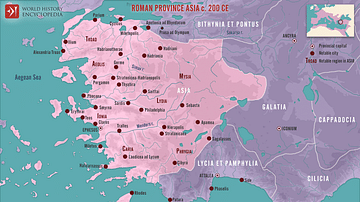
Roman Province Asia c. 200 CE
This map illustrates the Roman province of Asia around 200 CE. Established in 129 BCE following the bequest of the Attalid Kingdom of Pergamon to Rome, it encompassed western Anatolia (modern-day Turkey). It was a wealthy...
Image
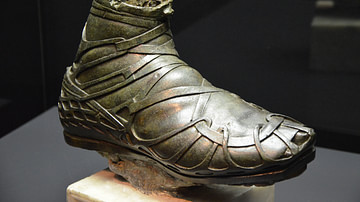
Bronze caliga from an over life-size statue of a Roman cavalryman
This bronze caliga was part of an over life-size statue of a Roman cavalryman from the 1st or the 2nd century CE. Caligae were heavy hob-nailed military boots worn by Roman legionary soldiers...
