
Search
Remove Ads
Advertisement
Search Results

Definition
Empire of Nicaea
The Empire of Nicaea was a successor state to the Byzantine Empire, or rather a Byzantine Empire in exile lasting from 1204 to 1261 CE. The Empire of Nicaea was founded in the aftermath of the sacking of Constantinople during...

Definition
Paolo Uccello
Paolo Uccello (1397-1475 CE), real name Paolo di Dono, was an Italian painter who is considered one of the founding fathers of Florentine Renaissance art. Uccello was one of the earliest artists to attempt certain tricks of perspective...

Definition
Claude Monet
Claude Monet (1840-1926) was a French impressionist painter who transformed modern art with his emphasis on light brushstrokes, bright colours, and uncluttered nature. Famed for his landscapes and series of paintings that captured...

Definition
Knights' Revolt
The Knight’s Revolt (1522-1523) was a military action led by the German imperial knight Franz von Sickingen (l. 1481-1523) and encouraged by the knight and writer Ulrich von Hutten (l. 1488-1523) launched to restore the status...
Definition
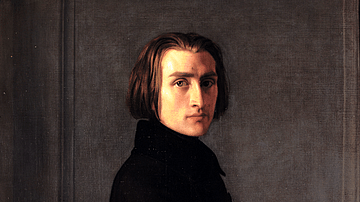
Franz Liszt
Franz Liszt (1811-1886) was a Hungarian composer of Romantic Music. Liszt first gained international fame as a piano virtuoso, an activity in which he was a pioneer, and then as a composer of piano works and symphonic poems, a form...

Definition
Jacques Offenbach
Jacques Offenbach (1819-1880) was a composer of German birth who took French citizenship and became famous in Paris for his comic operettas, a genre he created, and for the more serious opera, The Tales of Hoffmann. A virtuoso...

Definition
Crusader States
The Crusader States (aka the Latin East or Outremer) were created after the First Crusade (1095-1102) in order to keep hold of the territorial gains made by Christian armies in the Middle East. The four small states were the Kingdom...

Definition
Golden Horde
The Golden Horde was the European appanage of the Mongol Empire (1206-1368 CE). Begun in earnest by Batu Khan in 1227 CE, the territory that would eventually become the Golden Horde came to encompass parts of Central Asia, much of...
Definition
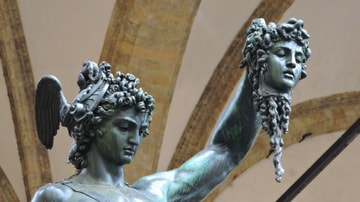
Benvenuto Cellini
Benvenuto Cellini (1500-1571 CE) was an Italian Renaissance sculptor, medallist, and goldsmith whose most famous works today include the bronze statue of Perseus holding the head of Medusa, which now stands in Florence, and a...

Definition
Petrarch
Petrarch (1304-1374 CE), full name Francesco Petrarca, was an Italian scholar and poet who is credited as one of the founders of the Renaissance movement in art, thought, and literature. Petrarch actively searched for 'lost' ancient...
