
Search
Remove Ads
Advertisement
Search Results

Article
The Invasion of Poland in 1939
The leader of Nazi Germany Adolf Hitler (1889-1945) ordered the invasion of Poland on 1 September 1939. Hitler's refusal to withdraw brought a declaration of war from Britain and France on 3 September, and so began...

Article
Daily Life in Ancient Egypt
The popular view of life in ancient Egypt is often that it was a death-obsessed culture in which powerful pharaohs forced the people to labor at constructing pyramids and temples and, at an unspecified time, enslaved...

Article
Why the Industrial Revolution Started in Britain
The Industrial Revolution saw a wave of technological and social changes in many countries of the world in the 18th and 19th centuries, but it began in Britain for a number of specific reasons. Britain...

Definition
Mauryan Empire
The Mauryan Empire (322 BCE - 185 BCE) supplanted the earlier Magadha Kingdom to assume power over large tracts of eastern and northern India. At its height, the empire stretched over parts of modern Iran and almost the entire...

Definition
The Saxons
The Saxons were a Germanic people of the region north of the Elbe River stretching from Holstein (in modern-day Germany) to the North Sea. The Saxons who migrated to Britain in the 5th and 6th centuries CE along with the Angles, Frisians...

Definition
Hyksos - The Rulers of Foreign Lands Who Transformed Egypt
The Hyksos were a West Semitic-speaking people who gained a foothold in Egypt circa 1782 BCE at the city of Avaris in Lower Egypt, thus initiating the era known in Egyptian history as the Second...
Definition
Trdat the Architect
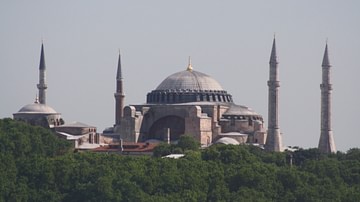
“Trdat the Architect” or Tiridates (c. 940s-c. 1020s?) was a Armenian architect who is noted for his role in the reconstruction of the Hagia Sophia's dome in Constantinople following an earthquake in the 10th century CE, as...

Definition
Serf
Medieval serfs (aka villeins) were unfree labourers who worked the land of a landowner (or tenant) in return for physical and legal protection and the right to work a separate piece of land for their own basic needs. Serfs made up 75%...

Definition
Medieval Japan
The medieval period of Japan is considered by most historians to stretch from 1185 to 1603 CE. Stand out features of the period include the replacement of the aristocracy by the samurai class as the most powerful social group...

Definition
Cimbri
The Cimbri were a tribe who lived in northern Jutland during the Roman era. Their ethnicity is enigmatic; scholars generally believe that the Cimbri were Germans, though others maintain that they were Celts. The late 2nd-century BCE migration...
