
Search
Remove Ads
Advertisement
Search Results

Definition
Isaac Newton
Isaac Newton (1642-1727) was an English mathematician and physicist widely regarded as the single most important figure in the Scientific Revolution for his three laws of motion and universal law of gravity. Newton's laws became...

Definition
Protestant Reformation
The Protestant Reformation (1517-1648) refers to the widespread religious, cultural, and social upheaval of 16th-century Europe that broke the hold of the medieval Church, allowing for the development of personal interpretations...

Definition
Philistines
The Philistines populated the coastal regions of Canaan from the 12th century BCE to their disappearance in 604 BCE. The word "Philistine" derives from the Hebrew ha-Plištim for the combination of several tribes of Syria and Judea...

Definition
Martin Bucer
Martin Bucer (l. 1491-1551) was a German reformer and theologian who had been a Dominican friar and priest until converted to the Protestant vision by Martin Luther (l. 1483-1546) c. 1518. Bucer is best known for his focus on unity...

Definition
Acropolis
An acropolis is any citadel or complex built on a high hill. The name derives from the Greek akro, "high" or "extreme/extremity" or "edge", and polis, "city", translated as "high city", "city on the edge" or "city in the air", the...

Definition
Roman Egypt
The rich lands of Egypt became the property of Rome after the death of Cleopatra VII in 30 BCE, which spelled the end of the Ptolemaic dynasty that had ruled Egypt since the death of Alexander the Great in 323 BCE. After the murder...

Definition
Attila the Hun
Attila the Hun (r. 434-453 CE) was the leader of the ancient nomadic people known as the Huns and ruler of the Hunnic Empire, which he established. His name means "Little Father" and, according to some historians, may not have...

Definition
Lebor Gabála Erenn
The Lebor Gabála Érenn or The Book of the Taking of Ireland, is a pseudo-historical collection of poetry and prose narrative which was first compiled in the 11th Century CE. The Lebor Gabála centers around an origin myth which...
Definition
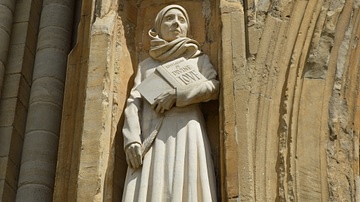
Julian of Norwich
Julian of Norwich (l. 1342-1416 CE, also known as Dame Julian, Lady Juliana of Norwich) was a Christian mystic and anchoress best known for her work Revelations of Divine Love (Julian's original title: Showings). Almost nothing...

Definition
Charles II of England
Charles II of England (r. 1660-1685) was the king of Scotland (1649-1685) before the Restoration in 1660 also made him king of England and Ireland. Charles was a charming and easygoing monarch who took a keen interest in sports...
