
Search
Did you mean: Giza?
Remove Ads
Advertisement
Search Results

Article
Trade in the Byzantine Empire
Trade and commerce were essential components of the success and expansion of the Byzantine Empire. Trade was carried out by ship over vast distances, although for safety, most sailing vessels were restricted to the...

Article
Global Trade in the 13th Century
In the 13th century, astonishing quantities of spices and silk passed from the Far East to Europe. Exact amounts are not known, but spice popularity in both cuisine and medicine reached its historical peak during...

Article
Society in the Byzantine Empire
The society in the Byzantine Empire (4th-15th century CE) was dominated by the imperial family and the male aristocracy but there were opportunities for social advancement thanks to wars, population movements, imperial...

Article
The Microscope & the Scientific Revolution
The microscope was one of the most significant inventions of the Scientific Revolution, opening up completely new and miniaturised worlds. The first microscopes were invented in the first quarter of the 17th...

Article
The Armies of the Crusades
The armies of the Crusades (11th-15th centuries CE), which saw Christians and Muslims struggle for control of territories in the Middle East and elsewhere, could involve over 100,000 men on either side who came from all...

Article
Life in a Renaissance Artist's Workshop
The majority of great Renaissance works of art were produced in large and busy workshops run by a successful master artist and his team of assistants and apprentices. Here, too, more mundane art was produced...
Article
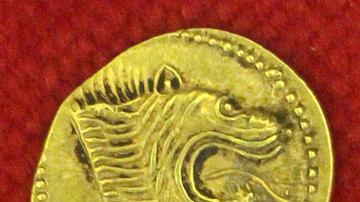
Etruscan Trade
The Etruscan civilization flourished in central Italy between the 8th and 3rd century BCE, and their prosperity was largely based on their exploitation of local mineral resources, both through manufactured goods and trade. The...
Article
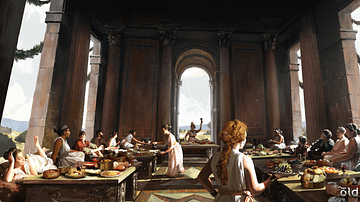
The Triumphal Feast of Vitellius
The emperor Aulus Vitellius (r. 69 CE) had never wanted to be Rome's emperor. Aulus was from a family of court flatterers to the first Caesars, and when his friend Nero (r. 54-68 CE) was dead, and there were no more...

Image
Agathocles of Syracuse
A gold coin from Syracuse depicting the tyrant Agathocles, 310-300 BCE. (Palazzo Blu, Pisa)
