
Search
Remove Ads
Advertisement
Search Results

Image
Greek and Phoenician Colonization
Both the ancient Greeks and Phoenicians extensively colonized vast areas of Europe, along the Mediterranean and Black Sea coasts. In doing so, they spread their culture, which strongly influenced the local tribes...

Definition
Ogham
One of the stranger ancient scripts one might come across, Ogham is also known as the 'Celtic Tree Alphabet'. Estimated to have been used from the fourth to the tenth century CE, it is believed to have been possibly named after the Irish...

Definition
Melqart
Melqart (also Melkarth or Melicarthus) was an important Phoenician god and patron deity of the city of Tyre. Associated with the monarchy, sea, colonization, and commercial enterprise, both at home and abroad the god is a significant...

Definition
Sejong the Great
King Sejong the Great (15 May 1397 to 8 April 1450 CE) ruled Korea from 1418 to 1450 CE as the fourth king of the Joseon Dynasty (also spelled Choson). One of only two Korean kings called 'the Great' today, Sejong had a major...
Image
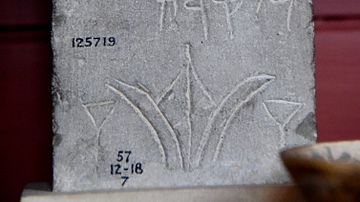
Phoenician Stela Dedicated to Tanit & Baal-Hammon
This light grey limestone stela was inscribed with six lines of Phoenician/Punic inscription; the upper line is almost lost. There is a lotus flower flanked by two standards at the lower part. There...
Video
History of the Alphabet (Language of Coins: 3/16)
History of the Alphabet. This video introduces the Hieroglyphic, Cuneiform, Hieratic, Demotic & Phoenician writing systems. It presents information as a series of selections from a finite collection...

Video
How Egypt invented the alphabet - History of Writing Systems #7 (Abjad)
From Egyptian hieroglyphs to your alphabet, watch these miners turn fancy symbols into simple scratches that were all about the sounds. First marvel at hieroglyphic inscriptions in...

Video
History of the Phoenicians: The Maritime Superpowers of the Mediterranean
The Phoenicians were the maritime superpowers of the Mediterranean. Their culture flourished and was at its most powerful between 1500 and 332 BCE when Alexander the Great entered...

Definition
Carthage
Carthage was a Phoenician city-state on the coast of North Africa (the site of modern-day Tunis) which, prior the conflict with Rome known as the Punic Wars (264-146 BCE), was the largest, most affluent, and powerful political entity...

Image
Phoenician Religious Sacrifice
A scene depicting a bird sacrifice, a common practice in the Phoenician religion from the sarcophagus of Ahiram, king of Byblos, 10th century BCE.
Beirut National Museum.
