
Search
Remove Ads
Advertisement
Search Results

Collection
Colonization in the Ancient Mediterranean
Colonization of the ancient Mediterranean had been taking place since the Bronze Age, especially with Minoan and Mycenaean expansion, but it was the Phoenicians from the 10th century BCE that really took the...

Article
The Punic Necropolis of Mahdia
The Punic funerary remains of Mahdia, a series of tombs carved into the rock, date back to a period between the 5th and the 2nd century BCE and are located in the northeast of Tunisia. These tombs are useful for us...

Definition
Ancient Egyptian Writing
Ancient Egyptian writing is known as hieroglyphics ('sacred carvings') and developed at some point prior to the Early Dynastic Period (c. 3150 -2613 BCE). According to some scholars, the concept of the written word was...

Definition
Norns - Female Figures of Fate
The norns were supernatural female entities responsible for the fates of all living beings in Viking Age Scandinavia. Associated with Yggdrasil, the world tree and central element of the nine realms of Norse cosmology...

Definition
Carthaginian Art
The art of the Carthaginians was an eclectic mix of influences and styles, which included Egyptian motifs, Greek fashion, Phoenician gods, and Etruscan patterns. Precious metals, ivory, glass, terracotta, and stone were transformed...

Image
Map of the Mediterranean Trade Networks, c. 700–350 BCE - Commerce & Colonization in the Archaic and Classical Ages
Between c. 700 and 350 BCE, the Mediterranean formed part of a broad and increasingly interconnected system of maritime and overland exchange linking...

Image
Sarcophagus of Ahiram
The Sarcophagus of Ahiram, king of Byblos, bearing the oldest inscription of the Phoenician alphabet, which reads: "Coffin which Ittobaal, son of Ahiram, king of Byblos, made for Ahiram, his father, when he placed him in...
Image
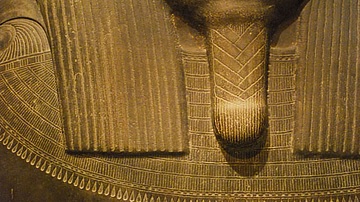
Eshmunazor II Sarcophagus
Sarcophagus of Eshmunazor II, king of Sidon. This sarcophagus is significant because it contains the longest known inscription in Phoenician writing. The king clearly shows an Egyptian style, with the fake beard and an...

Article
Carthaginian Trade
The Carthaginians, like their Phoenician forefathers, were highly successful traders who sailed the Mediterranean with their goods, and such was their success that Carthage became the richest city in the ancient world. Metals...

Definition
Tyrian Purple - The Super-Expensive Dye of Antiquity
Tyrian purple (aka Royal purple or Imperial purple) is a dye extracted from the murex shellfish which was first produced by the Phoenician city of Tyre in the Bronze Age. Its difficulty of manufacture...
