
Search
Remove Ads
Advertisement
Search Results
Image
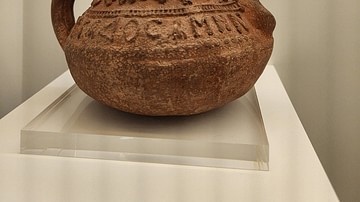
Oil Lamp with Running Animals & Greek Inscription
From a workshop in Upper Egypt.
The Greek inscription says "The Holy and Consubstantial Trinity Amen."
4th-5th century CE. Made from clay. (Hellenic Museum, Melbourne, Victoria).

Article
Trade in the Roman World
Regional, inter-regional and international trade was a common feature of the Roman world. A mix of state control and a free market approach ensured goods produced in one location could be exported far and wide. Cereals...

Lesson Pack
Economy & Trade in Ancient Greece
We have prepared five lesson plans including classroom activities, assignments, homework, and keys as well as: - Multiple choice quiz questions in an excel format - Glossary of keywords and concepts in an excel...

Definition
Second Continental Congress
The Second Continental Congress was the body of delegates that governed the Thirteen Colonies and, later, the United States during the American Revolutionary War. Between its first session in May 1775 and its disbandment...

Quiz
Economy & Trade in Ancient Greece
Emporia Emporioi Sitones Agora Sitophylakes Temperate Climate Import Export Amphora Stamp Obverse Reverse Numismatics greek trade economy colonies colonization colonisation olive oil wine pottery coin coinage

Definition
Ancient Olympic Games
The ancient Olympic Games were a sporting event held every four years at the sacred site of Olympia, in the western Peloponnese, in honour of Zeus, the supreme god of the Greek religion. The games, held from 776 BCE to 393...

Article
Colour & Technique in Renaissance Painting
There were three principal painting techniques during the Renaissance: fresco, tempera, and oils. In all of these techniques, colour was an important part of the painter's armoury, allowing them to create...

Interview
Dinner with the Romans: An Interview with Farrell Monaco
The ancient Romans left behind a wealth of remains which help archaeologists and historians to understand what daily life was like in the Roman Empire. From ancient frescos of rich table spreads...

Image
Trade in the Roman Empire Map (c. 200 CE)
This map shows the major sources of trade goods in the Roman Empire, circa 200 CE. The map shows the sources of the following trade goods: grain, olive oil, slaves, wine, metals, textiles and wild animals.

Article
The Egyptian Cinderella Story Debunked
The story of Cinderella is one of the most popular in the world. In the west, it has enjoyed a continuous following since its revision and publication by Charles Perrault in 1697 CE but the tale of the young...
