
Search
Remove Ads
Advertisement
Search Results

Article
Roman Women in Business
Roman women faced legal, ideological, and cultural limitations in several areas of their lives; deep-rooted traditions regarding the role of women in the Roman world resulted in pre-conceived views which saw women characterised...

Article
Slavery in Plantation Agriculture
The first plantations in the Americas of sugar cane, cocoa, tobacco, and cotton were maintained and harvested by African slaves controlled by European masters. When African slavery was largely abolished in the mid-1800s...

Article
The Women of Athena's Cult
In ancient Athens, women had no life outside the home unless they were prostitutes or were engaged in religious activities such as festivals. Every Greek deity in every city-state had their own cult (sect) but the cult...

Article
Threshing Floors of the Bible
The threshing floors of the Bible were outdoor stone floors, usually circular in fashion, used by farmers to process the grain of their crops. For the larger community, like watermills of the recent past, they could...

Article
Sojourner Truth's Escape from Slavery
Sojourner Truth's Escape from Slavery comes from the Narrative of Sojourner Truth, an account of the famous abolitionist's life as given to her friend and admirer Olive Gilbert and published in 1850. The story...
Article
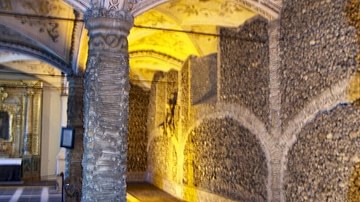
Skulls, Temples & Churches: A Visit to the Walled City of Evora
The sunbaked plain of the Alentejo region in central Portugal is called planicie dourada (golden plain) by the Portuguese, and it is dotted with cork oak forests, vineyards, olive groves...

Article
Food & Agriculture in Ancient Greece
The prosperity of the majority of Greek city-states was based on agriculture and the ability to produce the necessary surplus which allowed some citizens to pursue other trades and pastimes and to create a quantity...

Definition
Mycenaean Civilization
The Mycenaean civilization flourished in the Late Bronze Age (c. 1700-1100 BCE), peaking from the 15th to the 13th century BCE. The Mycenaeans extended their influence throughout the Peloponnese in Greece and across the Aegean...

Article
The Banquet Stele of Ashurnasirpal II
When he came to the throne in 884 BCE, Ashurnasirpal II had to attend to revolts which broke out across the empire. He ruthlessly put down all rebellions, destroyed the rebel cities and, as a warning to others...

Article
Caesarea Maritima's Role in the Mediterranean Trade
Caesarea Maritima was located on the eastern coast of the Mediterranean Sea. Built from the ground up in 22-10 BCE by Rome's client king, Herod the Great (r. 37-4 BCE), its location in relation to ship...
