
Search
Remove Ads
Advertisement
Search Results
Image
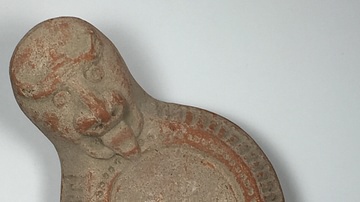
Egyptian Oil Lamp
This is a terracotta oil lamp with orange clay and dull orange slip. It features a hollow handle in the form of a gorgon's head. This is a decorative example of the type of oil lamp that was used to light one’s home. 2nd century...

Image
A Whale Oil Refinery at Smeerenburg, Svalbard
The whale oil refinery of the Amsterdam chamber of the Greenland Company on Amsterdam Island off the coast of Spitsbergen. Oil on canvas, 1639.
Image
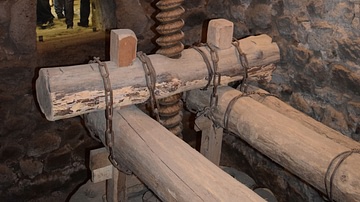
Oil Mill at Tatev Monastery
The oil mill at Tatev Monastery used to provide oil from hemp, lineseed, and sesame to monks and inhabitants who lived within a short distance from the monastery.
Image
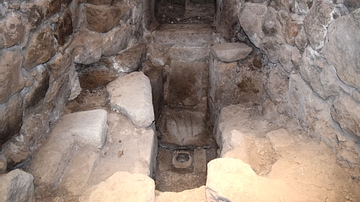
Tatev Monastery's Oil Mill
Oil mills have existed in Armenia since the Urartian era, and their archaeological remains can be found in all regions of Armenia. This oil mill at Tatev Monastery in Armenia dates from the 17th century CE.

Image
Roman Erotic Oil Lamp
A Roman terracotta oil lamp depicting an erotic scene between two women. From Anatolia. c. 1st Century BCE. (British Museum)
Image
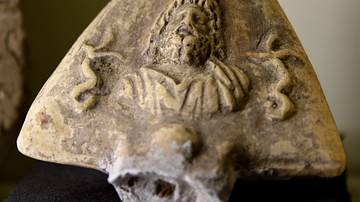
Egyptian Oil Lamp with Serapis
This is a fragment of a clay handle of a delta ceramic oil lamp; the loop handle is preserved. The fragment shows a bust of Serapis wearing a polis. From Egypt. Roman Period, 30 BCE to 641 CE. The Petrie Museum of...

Image
Roman oil lamp with erotic scene
Roman oil lamp with erotic motif, 1st - 3rd century CE. (Altes Museum, Berlin)
Image
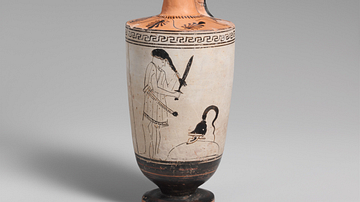
Attic Oil Flask Depicting a Scene from Seven Against Thebes
This image of a young warrior cutting his hair before battle may reflect a scene in Seven against Thebes, a tragedy by Aeschylus. The seven heroes knew that only one of them would survive battle...
Image
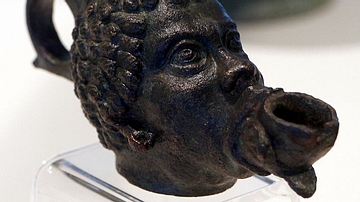
Bronze Oil Lamp in the Shape of an African Slave
This Roman oil lamp of unclear provenance was made in the 1st Century CE. It portrays an Aethiopian slave, with barbarians like Africans and Celts being popular motifs in Roman art. The lamp has also...

Image
Roman Terracotta Oil Lamp with a Rhinoceros Image
Terracotta oil lamp from Cyprus, the first half of the 1st century CE. The discus has an engraved image of a rhinoceros tossing a large cat with its horn.
Metropolitan Museum of Art, New York.
