
Search
Did you mean: Nisaba?
Remove Ads
Advertisement
Search Results

Definition
Thessaly and the Duchy of Neopatras
Thessaly was an independent state in medieval Greece from 1267 or 1268 to 1394 CE, first as the Greek-ruled Thessaly and later as the Catalan and Latin-ruled Duchy of Neopatras. Under its sebastokrators, Thessaly was a thorn in the side of...

Article
Early Christianity
Emerging from a small sect of Judaism in the 1st century CE, early Christianity absorbed many of the shared religious, cultural, and intellectual traditions of the Greco-Roman world. In traditional histories of Western culture, the emergence...

Article
Saladin's Conquest of Jerusalem (1187 CE)
Jerusalem, a holy city for the adherents of all three great monotheistic religions (Judaism, Christianity, and Islam) was conquered by the armies of the First Crusade in 1099 CE. The Muslims failed to halt their advance, as they were themselves...

Article
Women in the Byzantine Empire
Women in the Byzantine Empire (4th to 15th century CE) were, amongst the upper classes, largely expected to supervise the family home and raise children while those who had to work for a living did so in most of the industries of the period...

Article
The Capture of Jerusalem, 1099 CE
The capture of Jerusalem from Muslim control was the primary goal of the First Crusade (1095-1102 CE), a combined military campaign organised by western rulers, the Pope, and the Byzantine Empire. After a brief siege, the city was captured...

Article
Battles & Conquests Of The Ottoman Empire (1299-1683)
Spanning across three continents and holding dominance over the Black and Mediterranean Seas, the Ottoman Sultanate (1299-1922) was a global military superpower between the 15th and 17th centuries. From the point of its inception in 1299...

Article
Monotheism in the Ancient World
Monotheism is simply defined as the belief in one god and is usually positioned as the polar opposite of polytheism, the belief in many gods. However, the word monotheism is a relatively modern one that was coined in the mid-17th century...

Article
Christian Antisemitism in the Middle Ages & during the Reformation
Antisemitism is a modern term that describes prejudice and hostility to Jews and Judaism. The origins of Christian antisemitism in the gospels are based on the story of a 1st-century itinerant Jewish preacher, Jesus of Nazareth, in the Roman...
Article
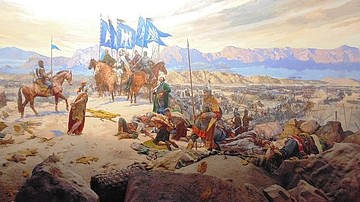
Battle of Manzikert
The Battle of Manzikert (Mantzikert) in ancient Armenia in August 1071 CE was one of the greatest defeats suffered by the Byzantine Empire. The victorious Seljuk army captured the Byzantine emperor Romanos IV Diogenes, and, with the empire...

Article
Hadrian's Travels
No other Roman emperor travelled as much as Hadrian (r. 117-138 CE). The 'restless' emperor spent more time travelling than in Rome, devoting half of his 21-year reign to the inspection of the provinces. His travels provided him with the...
