
Search
Remove Ads
Advertisement
Search Results

Definition
Constantine I
Constantine I, aka Constantine the Great, was Roman emperor from 306 to 337 CE. Realizing that the Roman Empire was too large for one man to adequately rule, Emperor Diocletian (284-305 CE) split the empire into two, creating a...
Definition
Alboin
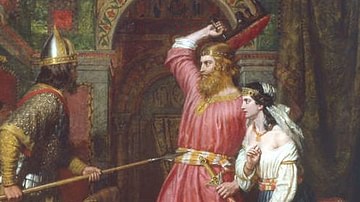
Alboin (r. 560-572 CE) was a king of the Lombards who led his people into Italy and founded the Kingdom of the Lombards which lasted from 568-774 CE. His father was Audoin, King of the Lombards, and his mother Queen Rodelinda. He was...

Definition
Persian Literature
Persian literature differs from the common definition of “literature” in that it is not confined to lyrical compositions, to poetry or imaginative prose, because the central elements of these appear, to greater or lesser degrees...

Definition
Islam
Islam is an Abrahamic-monotheistic religion based upon the teachings of Prophet Muhammad ibn Abdullah (l. 570-632 CE, after whose name Muslims traditionally add “peace be upon him” or, in writing, PBUH). Alongside Christianity and Judaism...

Definition
The Hittites
The Hittites occupied the ancient region of Anatolia (also known as Asia Minor, modern-day Turkey) prior to 1700 BCE, developed a culture apparently from the indigenous Hatti (and possibly the Hurrian) people, and expanded their...

Article
Byzantine-Armenian Relations
The relationship between the Byzantine Empire and ancient Armenia was a constant and varied one with an equal mix of wars, occupations, treaties of friendship, mutual military aid, and cultural exchange. Regarded as...

Definition
Maria Theresa - The Great Habsburg Empress
Maria Theresa (1717-1780) was the ruler of the Habsburg Monarchy, a sprawling empire that included Austria, Hungary, Bohemia, and other territories spread out across Italy, the Netherlands, and Central Europe...

Definition
Spanish Main
The Spanish Main refers, in its widest sense, to the Spanish Empire in the Americas from Florida in the north to the northern coast of Brazil in the south, including the Caribbean. The term was initially more limited and referred...

Definition
Leo III
Leo III was emperor of the Byzantine Empire from 717 to 741 CE. He founded the Isaurian dynasty which ruled until 802 CE. The emperor was a talented administrator, and he revamped the empire's political apparatus and legal code. Leo's...

Definition
Justinian I
Justinian I reigned as emperor of the Byzantine Empire from 527 to 565 CE. Born around 482 CE in Tauresium, a village in Illyria, his uncle Emperor Justin I was an imperial bodyguard who reached the throne on the death of Anastasius...
