
Search
Remove Ads
Advertisement
Search Results

Article
North Africa’s Place in the Mediterranean Economy of Late Antiquity
The Mediterranean Sea was the economic focal point of the Roman Empire. Rome's armies first established an empire across these waters beginning back in the times of the Roman Republic...

Definition
Fourth Crusade
The Fourth Crusade (1202-1204 CE) was called by Pope Innocent III (r. 1198-1216 CE) to retake Jerusalem from its current Muslim overlords. However, in a bizarre combination of cock-ups, financial constraints, and Venetian trading...

Image
The Babylonian King Nabonidus
This is a detail of a Babylonian basalt stele. Here the figure of the king, Nabonidus was carved in relief on the obverse side of the stele. The king stands and wears a conical headdress as well as a long fringed garment...

Image
Babylonian Lion
A pacing, roaring lion, once part of King Nebuchadnezzar II’s throne room in his palace in the ancient city of Babylon. These roaring lions emphasized the power and might of the Babylonian king. Babylon, Mesopotamia, modern-day...

Definition
Near East - A Modern Term for an Ancient Land
The 'Near East' is a modern-age term for the region formerly known as the 'Middle East,' comprising Armenia, Cyprus, Egypt, Iraq, Iran, Israel, Jordan, Lebanon, Palestine, Syria, and part of Turkey, corresponding...

Definition
Nergal - The Mesopotamian God of Death, War, and Destruction
Nergal (also known as Erra and Irra) is the Mesopotamian god of death, war, and destruction. He began as a regional, probably agricultural, god of the Babylonian city of Kutha in the Sumerian...

Image
12 Largest Contiguous Land Empires Before 1880 - From the Mongol Empire to Rome, Qing China & Russia
Land empires were expansive states whose rulers exercised authority over large, substantially connected territories and diverse populations. They grew through...
Definition
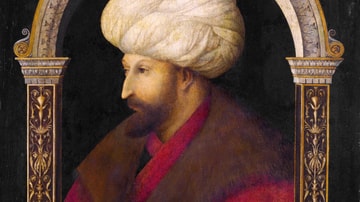
Mehmed II
Mehmed II (1432-1481 CE), also known as Mehmed the Conqueror, was the seventh and among the greatest sultans of the Ottoman Empire. His conquests consolidated Ottoman rule in Anatolia and the Balkans, and he most famously triumphed...
Definition
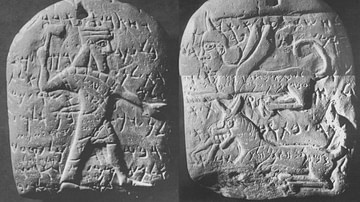
Arslan Tash Amulet
Dated to the 7th century BCE, the Arslan Tash amulet (AT1) was discovered in Arslan Tash, Syria and contains the writing of Phoenician, magic incantations. The limestone plaque includes a variety of features: incantations perceived...

Definition
Rashidun Government
The Rashidun Caliphate (632-661 CE) was responsible for setting up the basis of the Islamic empire and expanding its borders beyond the Arabian soil. These leaders were selected by the consent of the people and based on their...
