
Search
Remove Ads
Advertisement
Search Results

Article
The Death of Ur-Nammu - The Sumerian Vision of the Afterlife
The Death of Ur-Nammu is a Sumerian lament over the passing of the king Ur-Nammu (reign circa 2112-2094 BCE), founder of the Third Dynasty of Ur, who was killed in battle fighting the Gutians...

Article
A Supervisor's Advice to a Young Scribe
A Supervisor's Advice to a Young Scribe is a Sumerian composition relating a dialogue between an elder scribe and a young graduate from his school. The piece is dated to the Old Babylonian Period (c. 2000-1600...

Image
Maria Reiche in 1910
Maria Reiche (1903 - 1998 CE) was a German-born Peruvian mathematician and archaeologist known for her research into the Nazca Lines in Peru. This photograph was taken in 1910 CE.

Definition
Carthaginian Warfare
Carthaginian warfare has been overshadowed by defeat to Rome in the Punic Wars, but for six centuries before that Carthage was remarkably successful in conquering lucrative territories in North Africa, the Iberian Peninsula...
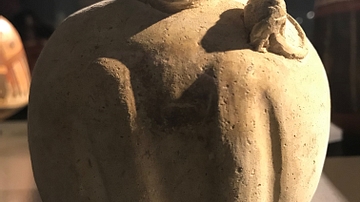
Image
Topara Ceremonial Vessel
This ceremonial vessel made of terracotta clay was created by the Topará Culture, which occupied and coexisted with the Paracas Culture in Paracas Peninsula and in the nearby Ica Valley in what is present-day Peru. The...

Image
Burial Mound, Cahuachi
A burial mound at the Nazca site of Cahuachi, southern Peru. The 40 mounds at the site are built on natural hilltops using earth and adobe-brick retaining walls. The site was used for burials and religious ceremonies between...
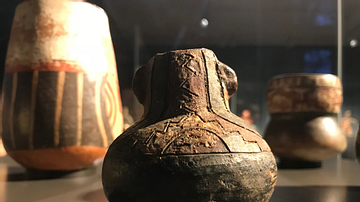
Image
Paracas Ceremonial Vessel
This ceremonial vessel made of terracotta clay comes from what is present-day Peru and was made by the Paracas Culture between the 8th-3rd centuries CE. The Paracas Culture was the forerunner to the Nazca civilization.
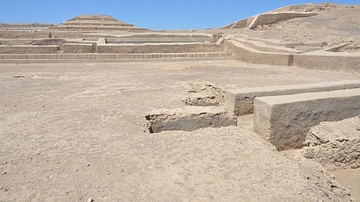
Image
Ceremonial Plaza, Cahuachi
A plaza for ceremonial gatherings and burial mound at the Nazca site of Cahuachi, southern Peru. The 40 mounds at the site are built on natural hilltops using earth and adobe-brick retaining walls. The site was used for...
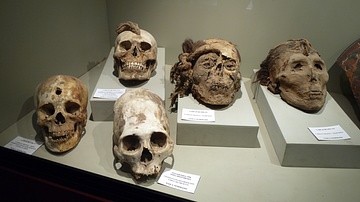
Image
Mummy Skulls, Cahuachi
Mummy skulls from the Nazca sacred burial site Cahuachi, southern Peru. The site was in use between 100 BCE and 550 CE.
Article
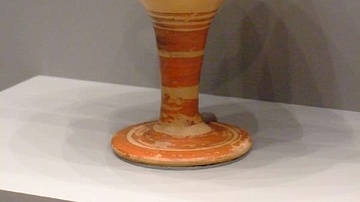
Mycenaean Pottery
The pottery of the Mycenaean civilization (1550-1050 BCE), although heavily influenced by the earlier Minoans based on Crete, nevertheless, added new pottery shapes to the existing range and achieved its own distinctive decorative...
