
Search
Remove Ads
Advertisement

 This answer was generated by
 Search Results

Definition
Code of Ur-Nammu - The Oldest Law Code in the World
The Code of Ur-Nammu (circa 2100-2050 BCE) is the oldest extant law code in the world. It was written by the Sumerian king Ur-Nammu (reign circa 2112-2094 BCE) or his son Shulgi of Ur (reign 2094 to...

Definition
Code of Hammurabi - The Most Influential Law Code of the Ancient World
The Code of Hammurabi was a set of 282 laws inscribed in stone by the Babylonian king Hammurabi (reign 1792-1750 BCE), who conquered and then ruled ancient Mesopotamia. Although his law...

Definition
Draco's Law Code
Draco was an aristocrat who in 7th century BCE Athens was handed the task of composing a new body of laws. We have no particular clues concerning his life and general biography and the only certainty is that, as an aristocrat...
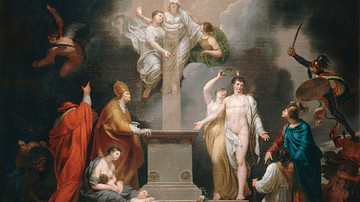
Article
Napoleonic Concordat of 1801 & Religious Pluralism
The Napoleonic Concordat of 1801 defined France's relationship with the Catholic Church for over 100 years. The Organic Articles were added in 1802 and provided state recognition of the Reformed and...

Definition
Hammurabi - Conquerer, King, and Law-Giver
Hammurabi (reign 1792-1750 BCE) was the sixth king of the Amorite First Dynasty of Babylon, best known for his famous law code, which served as the model for others, including the Mosaic Law of the Bible. He...

Definition
French Consulate
The French Consulate was the government of the First French Republic from 10 November 1799 to 18 May 1804, spanning the last four years of the Republic's existence. Headed by Napoleon Bonaparte (1769-1821) as First Consul, the...

Image
Map of Napoleonic Europe at its Greatest Extent - Rise and Fall of the French Imperial System, 1804–1815
The First French Empire under Napoleon Bonaparte (reign 1804-1814; 1815) marked the peak of French political and military dominance in Europe following the...

Image
Imperial Napoleonic Egg by Fabergé
The 1912 Imperial Napoleonic Egg by Peter Carl Fabergé (1846-1920). The egg was given by Tsar Nicholas II (r. 1894-1917) to his mother the Dowager Empress Marie Feodorovna. It commemorated the 100th anniversary...

Definition
Mesopotamian Government - Helping and Serving the Gods
Ancient Mesopotamian government was based on the understanding that human beings were created to help and serve the gods. The high priest, king, assembly of elders, governors, and any other officials...
Image
Code of Hammurabi
The Code of Hammurabi, a set of 282 laws inscribed in stone by the Babylonian king Hammurabi (r. 1795-1750 BCE).
Louvre, Paris.
