
Search
Remove Ads
Advertisement
Search Results
Article
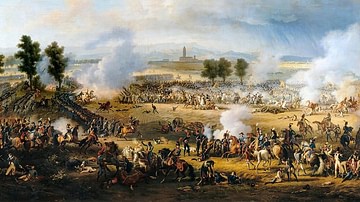
Battle of Marengo
The Battle of Marengo (14 June 1800) was one of the most important battles in the career of Napoleon Bonaparte (1769-1821). It not only helped bring the French Revolutionary Wars to an end but also did much to consolidate Bonaparte's...

Article
Battle of Eylau
The Battle of Eylau (7-8 February 1807) was a bloody but inconclusive military engagement during the Napoleonic Wars (1803-1815). Fought on the snowy fields of Poland, the two-day battle resulted in a draw. Eylau marked the first...

Article
Battle of Wagram
The Battle of Wagram (5-6 July 1809) was one of the largest and bloodiest battles of the Napoleonic Wars (1803-1815). It resulted in a pyrrhic victory for French Emperor Napoleon I (r. 1804-1814; 1815) whose army crossed the Danube...

Article
Battle of Arcole
The Battle of Arcole (15-17 November 1796), or Arcola, was a three-day battle fought between Napoleon Bonaparte's French Army of Italy and an Austrian army under József Alvinczi. Part of Napoleon's Italian Campaign, the battle...
Article
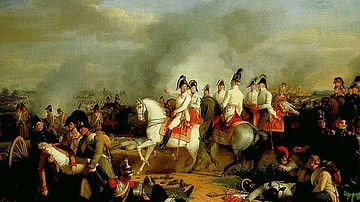
Battle of Aspern-Essling
The Battle of Aspern-Essling (21-22 May 1809) was a major battle of the Napoleonic Wars (1803-1815). It saw an Austrian army under Archduke Charles defeat a French army led by Emperor Napoleon I (r. 1804-1814; 1815) as...

Definition
August Decrees
The decrees of 4 August 1789, also known as the August Decrees, were a set of 19 articles passed by the National Constituent Assembly during the French Revolution (1789-1799) which abolished feudalism in France and ended the tax...

Article
Reforms of Catherine the Great
Catherine II of Russia (Catherine the Great) was the empress regent of Russia from 1762 to 1796. During the mid-18th century, Russia was still regarded as culturally behind compared to Western European countries. However...

Article
A Brief History of Veterinary Medicine
The English word 'veterinarian' as defining one who provides medical care to animals, comes from the Latin verb veheri meaning “to draw” (as in "pull") and was first applied to those who cared for “any animal...

Article
Mesopotamian Effects on Israel During the Iron Age
The Iron Age in the traditional Ancient Near Eastern chronology ranges from somewhere around 1200 BCE to 333 BCE. It begins from the era when it was first thought iron came to be used up to the ascendency...

Article
Balance & the Law in Ancient Egypt
Egyptian law was based on the central cultural value of ma'at (harmony and balance) which was the foundation for the entire civilization. Ma'at was established at the beginning of time by the gods when the earth...
