
Search
Remove Ads
Advertisement
Search Results

Article
Hipparchia the Cynic: Devoted Wife, Mother, & Outspoken Greek Philosopher
Cynic philosopher, wife of Crates of Thebes (l. c. 360 – 280 BCE), and mother of his children, Hipparchia of Maroneia (l. c. 350 – 280 BCE) defied social norms in order to live her...

Definition
Ishtar
Ishtar (Inanna in Sumerian sources) is a primary Mesopotamian goddess closely associated with love and war. This powerful Mesopotamian goddess is the first known deity for which we have written evidence. While largely unknown in the modern...

Definition
Inanna - The Most Popular Goddess of Ancient Mesopotamia
Inanna is the ancient Sumerian goddess of love, sensuality, fertility, procreation, and also of war. She later became identified by the Akkadians and Assyrians as the goddess Ishtar, and further...

Article
The Hymn to Ninkasi, Goddess of Beer - A Praise Song and Ancient Beer Recipe
The Hymn to Ninkasi is at once a song of praise to Ninkasi, the Sumerian goddess of beer, and an ancient recipe for brewing (though this claim has been challenged). Written down...

Definition
Hathor
Hathor is an ancient Egyptian goddess associated, later, with Isis and, earlier, with Sekhmet but eventually was considered the primeval goddess from whom all others were derived. She is usually depicted as a woman with the head of a...

Video
Olympias: Mother to Alexander the Great and Second Wife of Phillip II of Macedon
Olympias, born with the name Myrtle, was the daughter of Neoptolemus, the king of Epirus, which was a Greek kingdom southwest of Macedonia and became the second wife of Philip...

Article
Hygieia, the Goddess of Health
Modern medicine has its origin in the ancient world. The oldest civilizations used magic and herbs to cure their sick people, but they also used religion to free them from harm and to protect their health. The medical...

Article
Aztec Pantheon
The gods of the Aztecs (1345-1521 CE) were many and varied and, as with many other ancient cultures, deities were closely associated with things and events important to the culture and the general welfare of the community. These...
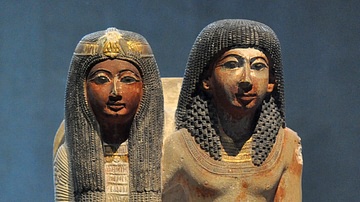
Image
Statue of Neje and His Mother
Limestone statue of the seated figure of priest Neje and Mutnefret, his mother. From modern-day Egypt. New Kingdom, 19th Dynasty, 13th and 12 centuries BCE. (State Museum of Egyptian Art, Munich, Germany).

Image
The King's Mother Tasherenese
The cobras on Tasherenese's headdress and forehead signal a royal status, and her fly-whisk was typical of queens. She was, however, not a queen. An inscription on the back-pillar identifies her as the mother of King...
