
Search
Remove Ads
Advertisement
Search Results
Image
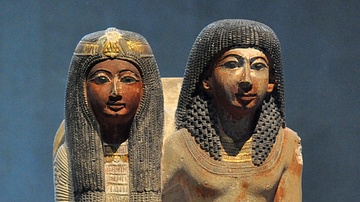
Statue of Neje and His Mother
Limestone statue of the seated figure of priest Neje and Mutnefret, his mother. From modern-day Egypt. New Kingdom, 19th Dynasty, 13th and 12 centuries BCE. (State Museum of Egyptian Art, Munich, Germany).
Image
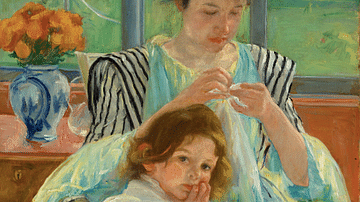
Young Mother Sewing by Cassatt
An 1890 oil on canvas, Young Mother Sewing, by Mary Cassatt (1844-1926), the American impressionist painter. (Metropolitan Museum of Art, New York)
Definition
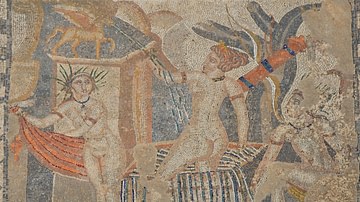
Diana
Diana was the goddess of childbirth, the fertility goddess, the goddess of the moon as well as the patron goddess of wild beasts in Roman mythology. However, she is best known as the goddess of the hunt, with her sacred animal being the...

Definition
Minerva
Minerva was the Roman goddess of wisdom, medicine, commerce, handicrafts, poetry, the arts in general, and later, war. In many ways similar to the Greek goddess Athena, she had important temples in Rome and was patron of the Quinquatras...

Definition
Tiamat - The Great Mesopotamian Goddess of Chaos
Tiamat is the Mesopotamian goddess associated with primordial chaos and the salt sea, best known from the Babylonian epic Enuma Elish. In all versions of the myth, following the original, Tiamat always...
Definition
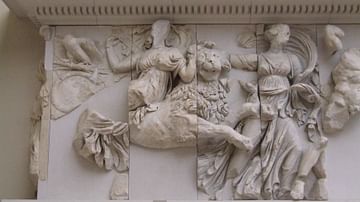
Rhea
Rhea (also spelt Rheia) is a Titan and a mother goddess in Greek mythology. She is the daughter of Gaia (Earth) and Uranus (Heaven) and the mother of the great deities of Mount Olympus. Rhea was closely associated with the Phrygian (Anatolian...

Definition
Serket
Serket (also known as Serqet, Selkis, and Selket) is an Egyptian goddess of protection associated with the scorpion. She was worshipped widely in Lower Egypt as a great Mother Goddess in the Predynastic Period (c. 6000- c. 3150 BCE) and...

Definition
Hecate
Hecate (Hekate) is a goddess of Greek mythology capable of both good and evil. She was associated with witchcraft, magic, the Moon, doorways, and creatures of the night like hell-hounds and ghosts. Hecate often carries a torch in her...

Definition
Anahita
Anahita is the ancient Persian goddess of fertility, water, health and healing, and wisdom. Owing to her association with life-giving properties, she also came to be connected with ancient Persian warfare as soldiers would pray to her...

Article
Ancient Persian Gods, Heroes, and Creatures - The Complete List
The term 'mythology' comes from the Greek mythos (story-of-the-people) and logos (word or speech), meaning the spoken story of a people. Every civilization of the ancient world developed a...
