
Search
Did you mean: Solon?
Remove Ads
Advertisement
Search Results
Definition
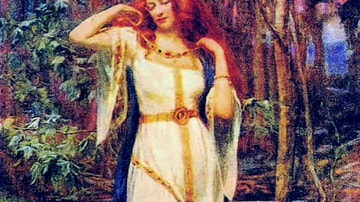
Freyja
Freyja (Old Norse for 'Lady', 'Woman', or 'Mistress') is the best-known and most important goddess in Norse mythology. Beautiful and many-functioned, she features heavily as a fertility goddess stemming from her place in the Vanir family...

Definition
Ancient Persian Religion
Ancient Persian religion was a polytheistic faith which corresponds roughly to what is known today as ancient Persian mythology. It first developed in the region known as Greater Iran (the Caucasus, Central Asia, South...

Definition
Avesta
The Avesta is the scripture of Zoroastrianism which developed from an oral tradition founded by the prophet Zoroaster (Zarathustra, Zartosht) sometime between c. 1500-1000 BCE. The title is generally accepted as meaning “praise”, though...

Definition
Parthian Religion
Parthian religion might be best described with two words: inclusive and evolving. As Parthia's empire held within it a variety of cultures, the Parthians wisely left each to their own beliefs and traditions, like the Seleucid...

Definition
Frigg
Frigg is a fertility goddess in Norse mythology. She is the wife of Odin, king of the gods, and is the greatest goddess of the Norse pantheon. She is thought to have developed, along with the goddess Freyja, from an earlier fertility...

Definition
Amun
Amun (also Amon, Ammon, Amen, Amun-Ra) is the ancient Egyptian god of the sun and air. He is one of the most important gods of ancient Egypt who rose to prominence at Thebes at the beginning of the period of the New Kingdom (c. 1570-1069...
Definition
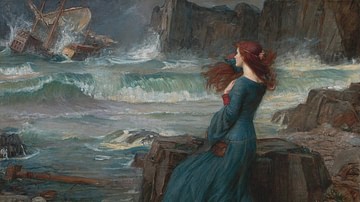
The Tempest - Shakespeare's Magical Tragicomedy
The Tempest is a play by William Shakespeare (c. 1564-1616), written in 1610 or 1611, and first performed for the court of James I of England (r. 1603-1625) on 2 November 1611. Believed to be the last play...

Definition
Kofun Period
Following the Yayoi Period of Japan when farming and metalworking techniques were introduced from mainland Asia was the Kofun Period (c. 250 CE - 538 CE) where the religion of Shinto emerges from the beliefs of previous eras and...

Definition
Phoenician Art
The art of the ancient Phoenicians, which flourished between the 19th and 4th centuries BCE, was exported throughout Mesopotamia and the ancient Mediterranean. Best known for their work on small decorative objects, Phoenician artists...

Definition
Carthaginian Art
The art of the Carthaginians was an eclectic mix of influences and styles, which included Egyptian motifs, Greek fashion, Phoenician gods, and Etruscan patterns. Precious metals, ivory, glass, terracotta, and stone were transformed...
