
Search
Did you mean: Texcoco?
Remove Ads
Advertisement
Search Results

Image
The Tarascan Empire
A map of Mexico indicating in green the extent of the Tarascan empire in the late Post-Classic period (1350-1520 CE) and the Tarascan capital of Tzintzuntzan. Indicated in grey is the contemporary Aztec empire.

Image
Lord Pacal
K'inich Janaab' Pacal otherwise known as Lord Pacal and Pacal the Great, 603-683 CE and Mayan king of Palenque. (National Museum of Anthropology, Mexico City)

Image
Temple of the Inscriptions, Palenque
The Temple of the Inscriptions at Palenque, Mexico. The pyramid was completed c. 682 CE and used as the tomb of the Maya king Kinich Janaab Pacal (r. 615-683 CE).

Image
Tulum
The Temple of the Winds at the ancient Mesoamerican site of Tulum, Mexico.
Image
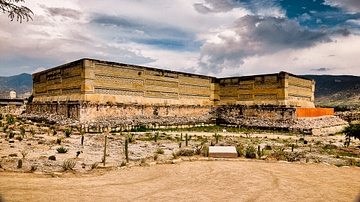
Hall of the Columns, Mitla
The Hall of the Columns, Mitla, Mexico. Late Post-Classic Period, 1300-1500 CE.
Image
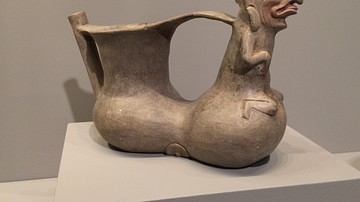
Zapotec Double-chambered Vessel
A double-chambered vessel with figured handle. Zapotec civilization, 300 BCE-300 CE, Mexico. (St. Louis Art Museum, Missouri)

Image
Maya Warriors
A Maya vessel decorated with warrior figures. They are wearing animal headdresses and have trophy heads hanging from their belts. From Mexico or Guatemala, c. 600-800 CE. (Brooklyn Museum, New York)

Image
Temple of Ehecatl, Calixtlahuaca
The Temple of Ehecatl at Calixtlahuaca, Toluca Valley, Mexico. Ehecatl was the Mesoamerican god of the Winds. Postclassic Period.

Image
Olmec Celtiform Ax
Jadeite celt, 10-4th century BCE, Mexico, Mesoamerica Metropolitan Museum of Art About 1000 BCE, celts-elongated, elliptical ground stone tools-would acquire meaning beyond their workaday function. When made of greenstones...

Image
Jadeite Olmec Mask
A mask of jadeite from the Olmec civilization of the Gulf coast, Mesoamerica, 900-500 BCE. Provenance: Rio Pesquero, Mexico. (Dallas Museum of Art)
