
Search
Did you mean: Texcoco?
Remove Ads
Advertisement
Search Results
Image
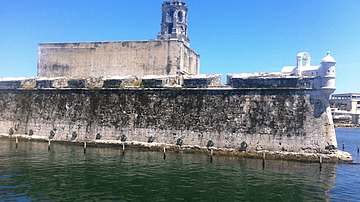
Fortifications, San Juan de Ulúa
A portion of the 16-17th century fortifications at San Juan de Ulúa, an island opposite the port of Veracruz, Mexico, once a major port on the Spanish Main. The rings in the walls were for ships to tie themselves...
Image
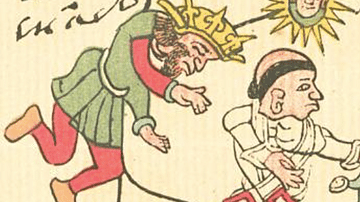
Death of Pedro de Alvarado
A scene from the 16th-century Codex Telleriano-Remensis showing the death of Pedro de Alvarado (c. 1485-1541), the Spanish conquistador who became the first governor of Guatemala in 1527. Alvarado was killed in Mexico...

Image
Juan de Grijalva Meeting a Maya Chief
A detail of a mural showing Juan de Grijalva (1489-1527), the Spanish conquistador who explored the coast of Mexico in 1518, meeting a Maya chief on the Tabasco coast.

Image
Pyramid of the Feathered Serpent, Xochicalco
A detail of the pyramid platform known as the 'Pyramid of the Feathered Serpent', Xochicalco, central Mexico. The four walls of the structure have relief carvings which include large feathered serpents...
Image
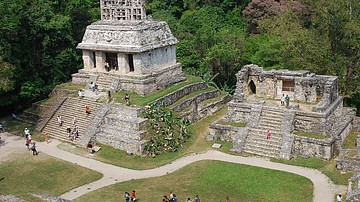
Temple of the Sun, Palenque
The Temple of the Sun at the Maya city of Palenque, Mexico. The temple was built in the late 7th century CE as part of the complex known as the Group of the Cross by King K'an Bahlam.

Image
Temple of the Frescoes, Tulum
The Temple of the Frescoes, Tulum, Mexico. 12-15th century CE.
Image
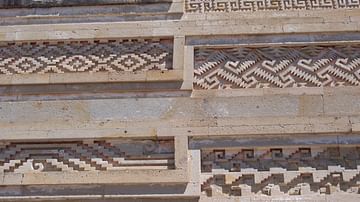
Wall Designs at Mitla
Details of the various designs which decorate panels of the House of the Columns, Mitla, Mexico. Post-Classic period. The designs may have been originally inspired by textile patterns and may actually represent family lineages...
Image
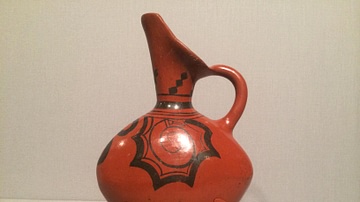
Aztec Spouted Jug
An Aztec spouted jug. Mexico, 1450-1521 CE. (St. Louis Art Museum, Missouri)

Image
Coyolxauhqui
The 3.2m diameter stone disk which depicts the decapitated and dismembered corpse of Coyolxauhqui. According to Aztec mythology the war god Huitzilopochtli chopped up the goddess when she tried to lead a rebellion against the gods...

Image
Ehecatl, God of the Winds
A statue of Ehecatl, the Mesoamerican god of the Winds. The eyes are of obsidian and he wears his typical beaked mask. Aztec, Late Postclassic period. (National Museum of Anthropology, Mexico City)
