
Search
Did you mean: Texcoco?
Remove Ads
Advertisement
Search Results

Video
What Montezuma's Aztec Sounded Like - and how we know
The Aztecs didn't call him Montezuma. Nor Moctezuma. They didn't call chocolate "chocolate". Heck, they didn't even call themselves Aztec! Though they were an oral culture, we have an idea of what...

Video
Katherine Rogers, Discusses Cranial Deformation in Chile
Kathering says, "I graduated from the University of California, Santa Barbara, with degrees in Anthropology, Communication, and Art History. I have traveled fairly extensively worldwide to destinations...

Video
Latin American Revolutions: Crash Course World History #31
In which John Green talks about the many revolutions of Latin America in the 19th century. At the beginning of the 1800s, Latin America was firmly under the control of Spain and Portugal. The...

Video
El Tajin, Pre-Hispanic City (UNESCO/NHK)
Located in the state of Veracruz, El Tajin was at its height from the early 9th to the early 13th century. It became the most important centre in north-east Mesoamerica after the fall of the Teotihuacan Empire...

Image
Kukulcan Sculpture, Chichen Itza
A representation of the feathered-serpent god Kukulkan at the base of the Castillo or Pyramid of Kukulcan at the Maya (and possibly later Toltec) centre of Chichen Itza, Yucatan, Mexico. The pyramid was built prior...
Image
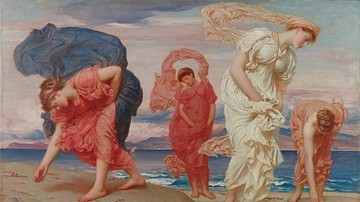
Greek Girls Picking up Pebbles by the Sea by Frederic Leighton
Greek Girls Picking up Pebbles by the Sea, oil on canvas by Frederic Leighton, 1871.
Collection Pérez Simón, Mexico
Image
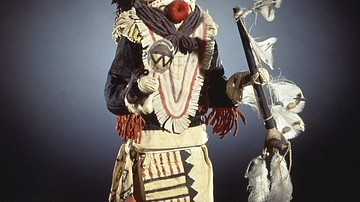
Zuni Kachina Doll
She-we-na (Zuni Pueblo). Kachina doll (Paiyatemu), made of wood, pigment, horsehair, feathers, wool, hide, cotton, tin, ribbon, 22 1/2 x 9 x 8 in. (57.2 x 22.9 x 20.3 cm), from Zuni, New Mexico, late 19th century. Brooklyn Museum...

Image
Coatlicue
A colossal basalt statue of Coatlicue ('Serpent Skirt'), the Aztec mother-earth goddess and mother of Huitzilopochtli. The goddess is represented with a severed head replaced by two snake heads, wearing a necklace of severed hands...

Image
Aztec Empire
A map indicating the maximum extent of the Aztec civilization which flourished between c. 1345 and 1521 CE in what is now Mexico. The three major cities which formed the Aztec Triple Alliance were Tenochtitlan, Texcoco and Tlacopan...

Image
The Caracol, Chichen Itza
The Caracol or Observatory of Chichen Itza, Mexico. Constructed prior to 800 CE, this Maya building was used as an astronomical observatory, especially of Venus.
