
Search
Remove Ads
Advertisement
Search Results

Collection
Ancient Persian Religion & Mythology
Ancient Persian religion developed in the region of Greater Iran by the 3rd millennium BCE and corresponds to what is known today as ancient Persian mythology. This belief system informed the Persian Achaemenid...
Collection
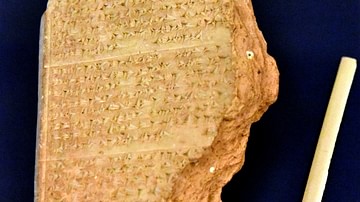
Twelve Stories from the Mesopotamian Scribal School
Sumerian schools (known as edubba, “House of Tablets”) trained the scribes of ancient Mesopotamia in reading, writing, interpretation of texts, general knowledge, and the specifics of whatever field...

Definition
Near East - A Modern Term for an Ancient Land
The 'Near East' is a modern-age term for the region formerly known as the 'Middle East,' comprising Armenia, Cyprus, Egypt, Iraq, Iran, Israel, Jordan, Lebanon, Palestine, Syria, and part of Turkey, corresponding...

Definition
Mesopotamia - The Beginning of Beginnings
Mesopotamia (from the Greek, meaning "between two rivers") was an ancient region located in the Near East (Middle East) bounded in the northeast by the Zagros Mountains and in the southeast by the Arabian Plateau...

Article
Trade in Ancient Mesopotamia - How Commerce Encouraged Civilization
Local trade in ancient Mesopotamia began in the Ubaid period (circa 6500-4000 BCE), had developed into long-distance trade by the Uruk period (circa 4000-3100 BCE), and was flourishing by...

Definition
Elam - The Ancient High Country
Elam was a region in the Near East corresponding to the modern-day provinces of Ilam and Khuzestan in southern Iran (though it also included part of modern-day southern Iraq) whose civilization spanned thousands of...
Image
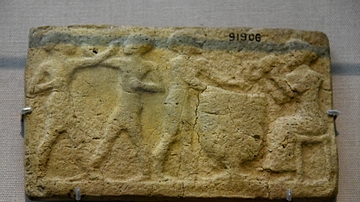
Mesopotamian Boxers & Musicians Plaque
Two boxers are fighting while two musicians are playing the drum and are beating clappers together. Old Babylonian Period, 2000-1600 BCE. From Larsa, Southern Mesopotamia, modern-day Iraq. (The British Museum...
Image
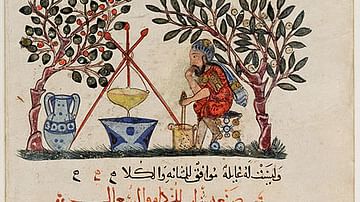
Ancient Mesopotamian Pharmacist Prepares Elixir
An Arab folio on which is depicted a pharmacist preparing an elixir. From the manuscript of the De Materia Medica by Dioscorides, 1st century CE. Metropolitan Museum of Art, New York

Article
The Nimrud Dogs - The Security System of Ancient Mesopotamia
The Nimrud Dogs, five clay canine figurines found at the ancient Mesopotamian city of Nimrud, were only a few of the many startling finds in the region in the 20th century. During the 19th century...

Definition
Ereshkigal - Mesopotamian Queen of the Dead
Ereshkigal (also known as Irkalla and Allatu) is the Mesopotamian Queen of the Dead, who rules the underworld. Her name translates as "Queen of the Great Below" or "Lady of the Great Place." She was responsible...
