
Search
Remove Ads
Advertisement
Search Results
Image
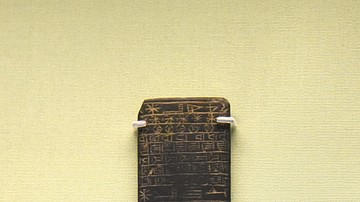
Mesopotamian Amulet Against Ghosts
Stone inscribed with an incantation that has 7 signs, repeated 7 times. It is much worn through use. From Mesopotamia, modern-day Iraq, c. 800-550 BCE.
The British Museum, London.

Video
Thor the God of Thunder in Norse Mythology
Thor, the god of the sky, thunder and agriculture in Norse Mythology, is best known today from his depiction as a superhero in graphic novels and movies which draw on his role in tales from Norse Mythology...

Video
Terrifying Monsters from Mythology and Folklore Around the World
Monsters as forces of chaos are popular figures in world mythology so stick around for a glimpse of the terrifying monsters from mythology and folklore from around the world. Monsters and...
Image
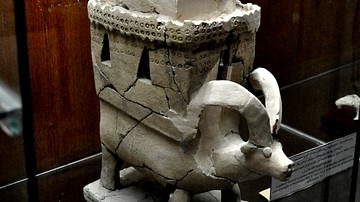
Mesopotamian Incense Container
A pottery incense container found at layer 5 of the altar platform of the central temple of Basmosian Hill, Mesopotamia, Hurrian period, 2nd millennium BCE.
Sulaimaniya Museum, Iraq.
Image
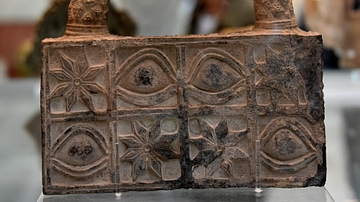
Mesopotamian Carved Stone with Integral Handle
This carved grey stone has an integral handle. It was possibly a weight. There are eight compartments decorated with the shapes of eyes and rosettes. The handle imitates basketry and is ornamented with...
Image
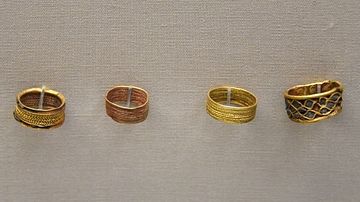
Mesopotamian Finger Rings
These rings were found on the fingers of a woman named Puabi, inside her grave. Puabi was a Semitic Akkadian woman from Ur, c. 2600 BCE, possibly a queen or priestess. Two rings were made of gold wire that was twisted...
Image
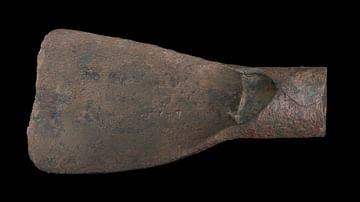
Mesopotamian Hoe
Copper alloy hoe blade with socket, from Ur, Early Dynastic III, 2600-2300 BCE.
The British Museum, London.
Image
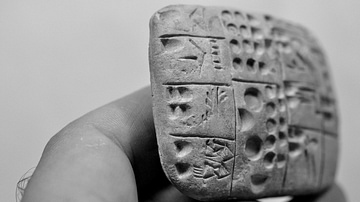
Side View, Illegally Excavated Mesopotamian Clay Tablet
This clay tablet was illegally excavated. The precise provenance of the excavation is unknown, but probably from Southern Mesopotamia, modern-day Iraq. It is currently housed in the Sulaymaniyah...
Image
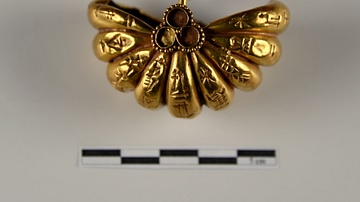
Mesopotamian Gold Earring, Ur III
This is the upper surface of the earring . The right lower circle is broken and at the center of the trifoliate group lies a single golden sphere. The cuneiform text is read vertically, from the upper surface downwards...
Image
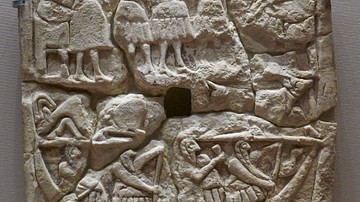
Mesopotamian Banquet Scene
Perforated votive plaque with a banquet scene, Mesopotamia, modern-day Iraq, c. 2700-2600 BCE.
Louvre, Paris.
