
Search
Remove Ads
Advertisement
Search Results

Definition
The Kingdom of Kush
Kush was a kingdom in northern Africa in the region corresponding to modern-day Sudan. The larger region around Kush (later referred to as Nubia) was inhabited c. 8,000 BCE but the Kingdom of Kush rose much later. The Kerma Culture, so named...

Definition
Ogham
One of the stranger ancient scripts one might come across, Ogham is also known as the 'Celtic Tree Alphabet'. Estimated to have been used from the fourth to the tenth century CE, it is believed to have been possibly named after the Irish...

Definition
Elam - The Ancient High Country
Elam was a region in the Near East corresponding to the modern-day provinces of Ilam and Khuzestan in southern Iran (though it also included part of modern-day southern Iraq) whose civilization spanned thousands of years from circa 3200 to...

Definition
Alphabet
The history of the alphabet started in ancient Egypt. By 2700 BCE Egyptian writing had a set of some 22 hieroglyphs to represent syllables that begin with a single consonant of their language, plus a vowel (or no vowel) to be supplied by...

Definition
Chogha Zanbil - The "Basket Mound" of the Gods
Chogha Zanbil (literally "basket mound") is an ancient Elamite temple complex located in the modern-day province of Khuzestan, Iran. It is also known as Dur-Untash (Fortress/City/Town of Untash), Tchogha Zanbil, and Al Untash Napirisha ("Place...

Definition
Indus Valley Civilization
The Indus Valley Civilization was a cultural and political entity which flourished in the northern region of the Indian subcontinent between c. 7000 - c. 600 BCE. Its modern name derives from its location in the valley of the Indus River...
Definition
The Edicts of Ashoka the Great
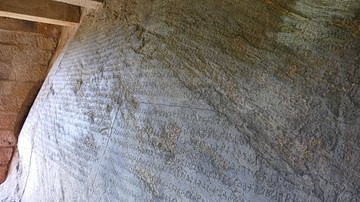
The Edicts of Ashoka are 33 inscriptions engraved on pillars, large stones, and cave walls by Ashoka the Great (r. 268-232 BCE), the third king of the Mauryan Empire (322-185 BCE) of India. One set, the so-called Major Rock Edicts, are consistent...

Definition
Mesopotamian Literature - The Earliest Works of the Imagination
Ancient Mesopotamian literature developed circa 2600 BCE after scribes, who had formerly been record-keepers, began composing original works in the region of Sumer. The Sumerians invented writing circa 3600/3500 BCE, refined the script circa...

Definition
Sumerian Language
The Sumerian language was spoken in southern Mesopotamia before the 2nd millennium BCE and was the first language to be written in the cuneiform script. It is an isolate language meaning we know of no other languages that relate to it ancestrally...

Article
Scribes in Ancient Mesopotamia - The Beginning of History
Scribes in ancient Mesopotamia were highly educated individuals trained in writing and reading on diverse subjects. Initially, their purpose was to record financial transactions through trade, but in time, they were integral to every aspect...
