
Search
Remove Ads
Advertisement
Search Results
Definition
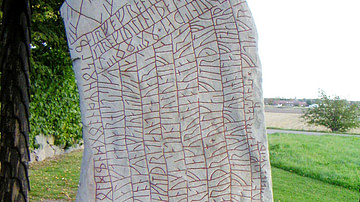
Runes
Runes are letters in the runic alphabets of Germanic-speaking peoples, written and read most prominently from at least c. 160 CE onwards in Scandinavia in the Elder Futhark script (until c. 700 CE) and the Younger Futhark - which illuminated...

Image
Clay Tablet with Linear A Script
A clay tablet from Zakros, Crete inscribed with Linear A script. Still undeciphered, Linear A script was used by the Minoan civilization from c. 1850 to c. 1450 BCE. (Zakros Archaeological Museum)

Image
Unicorn Seal - Indus Script
A seal with Indus Script, c. 2700-2000 BCE.
Image
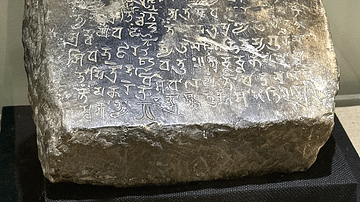
Rock Inscription Written in Brahmi Script
Rock inscription written in Brahmi Script, Gandhara, 5th-7th century.
Islamabad Museum, Pakistan.

Article
Cultural Links between India & the Greco-Roman World
Cyrus the Great (558-530 BCE) built the first universal empire, stretching from Greece to the Indus River. This was the famous Achaemenid Empire of Persia. An inscription at Naqsh-i-Rustam, the tomb of his able successor Darius I (521-486...
Image
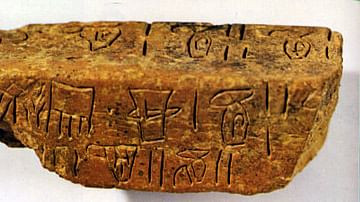
Linear A Script
An example of a Minoan Linear A tablet.
Image
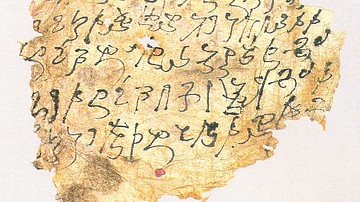
Kharosthi Script
An example of a Kharosthi inscription on paper found at Yingpan in the Tarim Basin (northwest China) dated to the 2nd to 5th century CE.
Image
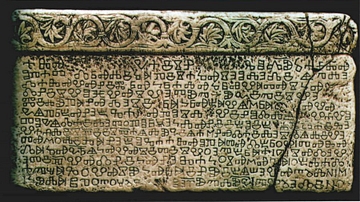
Glagolitic Script
A 12th century CE tablet known as the Baska Tablet from Croatia. The Glagolitic script on the tablet was created by Saint Cyril (d. 867 CE), the Byzantine missionary to the Balkans and central Europe. It was the forerunner to the Cyrillic...
Image
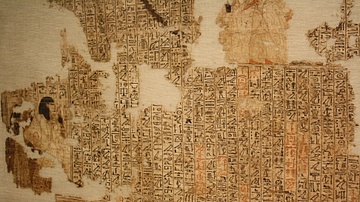
Egyptian Book of the Dead, Pashed Script
A portion of an Egyptian Book of the Dead in the hieroglyphic cursive script of Pashed. Papyrus. XVIII-XIX Dynasty. (Archaeological Museum, Milan, Italy)
Image
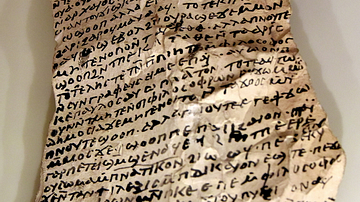
Coptic Script About a Church Dispute
This limestone fragment (ostracon) is written with a Coptic script about the dispute of the church father Kyrill. From Thebes, Egypt. Byzantine Period, 4th to 7th century CE. (The Neues Museum, Berlin, Germany).
