
Search
Remove Ads
Advertisement
Search Results

Article
Roman Expeditions in Sub-Saharan Africa
Sub-Saharan Africa was explored by Roman expeditions between 19 BCE - 90 CE, most likely in an effort to locate the sources of valuable trade goods and establish routes to bring them to the seaports on the coast of North Africa, thereby minimizing...

Article
Greco-Bactrian and Indo-Greek Kingdoms in Ancient Texts
The rarity of the appearance of Greco-Bactrian and Indo-Greek kingdoms in ancient literature is one of the reasons why those states are so little-known today. Indo-Greek literature did exist, but none has been found that speaks about the...

Article
Ancient Egyptian Medical Texts
Medicine in ancient Egypt was understood as a combination of practical technique and magical incantation and ritual. Although physical injury was usually addressed pragmatically through bandages, splints, and salves, even the broken bones...

Definition
Mycenaean Society
Mycenaean society was strictly hierarchical, valued family lineage, and awarded higher social status to those involved with religious or military activities and palatial administration. The lower classes contained craftsmen and artisans who...

Definition
Shang Dynasty
The Shang Dynasty (c. 1600-1046 BCE) was the second dynasty of China, which succeeded the Xia Dynasty (c. 2070-1600 BCE) after the overthrow of the Xia tyrant Jie by the Shang leader, Tang. Since many historians question whether the Xia Dynasty...

Definition
Second Intermediate Period of Egypt
The Second Intermediate Period (c. 1782 - c.1570 BCE) is the era following the Middle Kingdom of Egypt (2040-1782 BCE) and preceding the New Kingdom (1570-1069 BCE). As with all historical designations of the eras of Egyptian history, the...

Definition
Avesta
The Avesta is the scripture of Zoroastrianism which developed from an oral tradition founded by the prophet Zoroaster (Zarathustra, Zartosht) sometime between c. 1500-1000 BCE. The title is generally accepted as meaning “praise”, though this...

Image
Chain of Ankhs
Gold chain of ankhs (signs of life; also known as key of life, the key of the Nile, or crux ansata). From the treasure of the Nubian queen Amanishakheto, pyramid N6, Meroe, modern-day northern Sudan. Meroitic period, around 1 CE. (State Museum...
Image
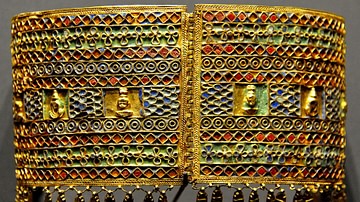
Armlet from Meroe
Gold armlet with pendants and busts of gods. From the treasure of the Nubian queen Amanishakheto, pyramid N6, Meroe, modern-day northern Sudan. Meroitic period, around 1 CE. (State Museum of Egyptian Art, Munich, Germany).

Image
Chain with Hathor Heads
Golden chain links in the shape of Hathor heads. From the treasure of the Nubian queen Amanishakheto, pyramid N6, Meroe, modern-day northern Sudan. Meroitic period, around 1 CE. (State Museum of Egyptian Art, Munich, Germany).
