
Search
Did you mean: Marduk?
Remove Ads
Advertisement
Search Results

Image
Map of Timur’s Empire and Campaigns, 1370–1405 - The rise and the expansion of Tamerlane across Eurasia
The Timurid Empire under Timur (reign 1370–1405) emerged from the fragmented political world of the western Chagatai Khanate in Central Asia. Born near Kesh...

Image
Map of Europe Before the Fall of Constantinople, c. 1450 - Political Europe and the Eastern Mediterranean
Around 1450 CE, Europe and the eastern Mediterranean stood at the intersection of declining medieval powers and emerging regional states. The Byzantine Empire...

Image
Map of the Travels of Leo Africanus, c. 1509–1518 - Africa, Trade and Empires in the Early 16th Century
The travels of Leo Africanus (al-Hasan ibn Muhammad al-Wazzan al-Fāsī, c. 1494–c. 1554) illuminate the political, commercial, and cultural connections of early...
Image
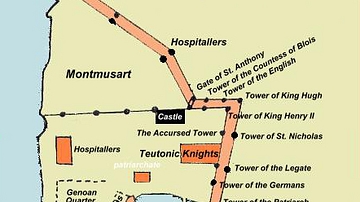
Plan of Acre, 1291 CE
A plan of the city of Acre at the time of the 1291 CE siege by the Mamluk Sultanate.
Image
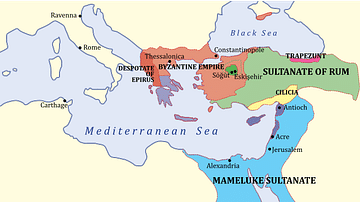
The Levant, 1263 CE
A map showing the various states of the Levant c. 1263 CE.
Light Blue: Mamluk Sultanate
Dark Blue: Latin East
Image
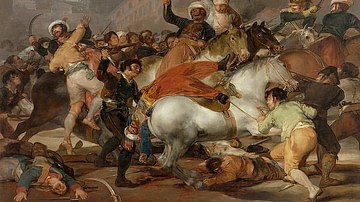
The Uprising of 2 May 1808, or The Charge of the Mamluks
The Uprising of 2 May 1808, or The Charge of the Mamluks, oil on canvas by Francisco Goya, 1814, part of a series of artworks depicting the horrors of the Peninsular War (1807-1814). This work depicts...
Image
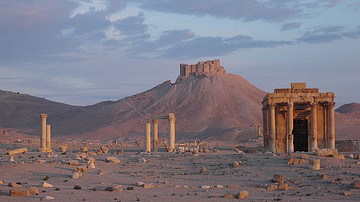
Palmyra Castle
Photo of Palmyra's 13th century CE Mamluk castle with ancient ruins in the foreground.
Image
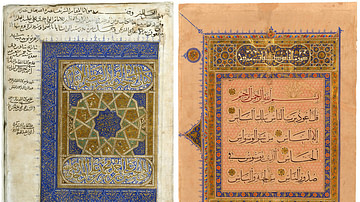
Al-Wajiz Commentary Folio
An abridged commentary on the Qur’an from Mamluk Egypt, 1478.
Museum no. MSL/1869/7219, folio 2a. © Victoria and Albert Museum, London
Image
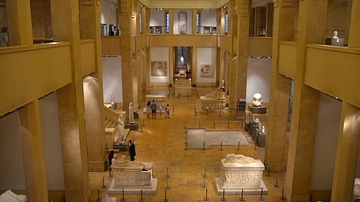
National Museum of Beirut, Lebanon
The National Museum of Beirut is the principal museum of archaeology in Lebanon. About 1300 artifacts are exhibited, ranging in date from prehistoric times to the medieval Mamluk period.
Image
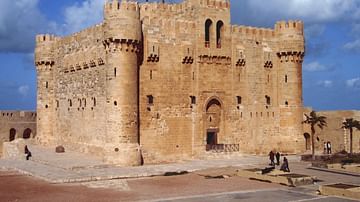
Fort Qaitbey
Fort Qaitbey, Alexandria, Egypt, built by the Mamluk ruler Quait-bey (r. 1468-1496 CE) between 1477-1480 CE.
The fort stands a the site of the ancient Lighthouse of Alexandria, one of the Seven Wonders of the Ancient World.
