
Search
Remove Ads
Advertisement
Search Results

Definition
Herakleia Lynkestis
Herakleia Lynkestis (Heraclea Lyncestis; Ἡράκλεια Λυγκηστίς) was a city in the ancient kingdom of Macedon not far from modern Bitola, founded c. 358 BCE by Philip II of Macedon (r. 359-336 BCE) as a governing centre for his...

Definition
Pezhetairoi
The pezhetairoi (foot companions) were part of the imposing army that accompanied the Macedonian commander Alexander the Great (r. 336-323 BCE) when he crossed the Hellespont to face the Persian king Darius III in 334 BCE. Armed with...
Image
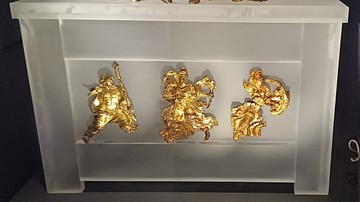
Macedonian Burial Casket Decorations from Pydna
Grave goods from a male burial in the necropolis of Pydna, c. 330 BCE. Archaeological Museum of Thessaloniki, acc. no. Py4285. The ancient city of Pydna (near today's small town of Makrygialos) was...

Article
Hellenistic & Roman Agora of Athens
Pericles’ agora of Athens flourished under Macedonian control. After Macedon was defeated by Rome, the Romans added to the district even before Greece was taken as a province and more so afterwards. The Roman version...
Definition
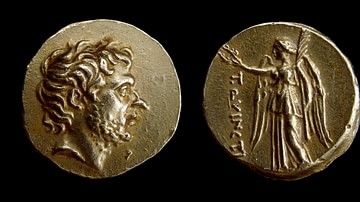
Titus Quinctius Flamininus
Titus Quinctius Flamininus (229-174 BCE) was a consul and military commander of the Roman Republic during the Second Macedonian War, who decisively defeated Philip V of Macedon (r. 221-179 BCE) at the Battle of Cynoscephalae...
Article
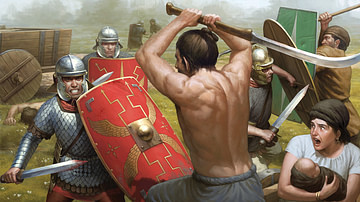
Legions of the Dacian Wars
The Dacian Wars started after Decebalus (r. c. 87-106 CE) raided the Roman province of Moesia in 85 CE. Emperor Domitian's (r. 81-96 CE) Dacian campaigns in 86-87 CE reached an uneasy peace, but the conflict was renewed...

Image
Map of the Macedonian Kingdom at Philip II's Death c.336 BCE - Legacy and the Road to Imperial Expansion
At the time of Philip II’s death (reign 359–336 BCE), the Kingdom of Macedon had emerged as the dominant power in the Hellenic world. Through sustained military...

Article
Dragoons in the English Civil Wars
Dragoons were hybrid cavalry-infantry troops during the English Civil Wars (1642-1651). They usually dismounted before fighting and were used primarily as support troops. Dragoons were frequently tasked with capturing...

Definition
Hypaspist
The hypaspists or hypaspistai were a distinct type of infantry soldier who served as a vital part of the Macedonian armies of both Phillip II of Macedon (r. 359 BCE - 336 BCE) and his son and heir Alexander the Great (r. 336-323 BCE...

Article
Musketeers in the English Civil Wars
Musketeers played a vital role in the battles and sieges of the English Civil Wars (1642-1651). As the war dragged on, weapons became lighter and more accurate, and the musketeers became more capable of effective...
