
Search
Remove Ads
Advertisement
Search Results

Definition
Acropolis
An acropolis is any citadel or complex built on a high hill. The name derives from the Greek akro, "high" or "extreme/extremity" or "edge", and polis, "city", translated as "high city", "city on the edge" or "city in the air", the...

Definition
Battle of Chaeronea
The Battle of Chaeronea took place in 338 BCE on an early August morning outside the town of Chaeronea. Although for centuries the cities of Athens and Sparta dominated Greece, politically, militarily and economically, the...

Definition
Bucchero
Bucchero wares are a shiny dark grey to black pottery produced by the Etruscans of central Italy from the 7th to 4th century BCE. Used for everyday purposes and as funerary and votive objects, bucchero incorporates many forms from simple...

Definition
Byzantine Architecture
The architecture of the Byzantine Empire (4th - 15th century CE) continued its early Roman traditions but architects also added new structures to their already formidable repertoire, notably improved fortification walls and...
Definition
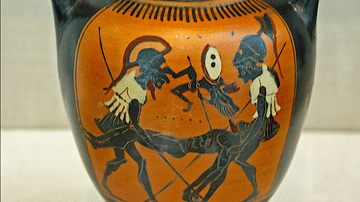
Thanatos
Thanatos is the personification of Death in Greek mythology. He is the son of Nyx (Night) and the twin brother of Hypnos (Sleep). Some sources also name Erebus (Darkness) as his father. As the personification of Death, Thanatos works...
Definition
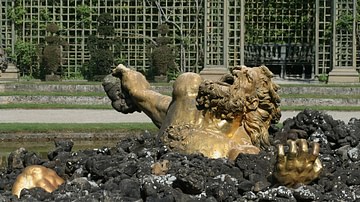
Giants
In Greek mythology, the Giants (Gigantes) are an aggressive race of creatures who were born from Gaia (the Earth) after drops of Uranus' blood fell on the Earth after he was castrated. The Giants had great strength and were fearsome to...

Definition
Nymph
A nymph (Greek: νύμφη, nymphē) in Greek and in Roman mythology is a young female deity typically identified with natural features such as mountains (oreads), trees and flowers (dryads and meliae), springs, rivers, and lakes (naiads) or...
Definition
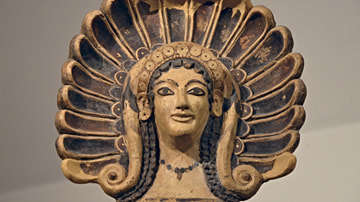
Etruscan Pottery
Etruscan pottery, produced over five centuries, was nothing if not varied. Indigenous wares such as the glossy black bucchero were made alongside red- and black-figure pottery imitating, yet modifying those produced in the Greek...
Definition
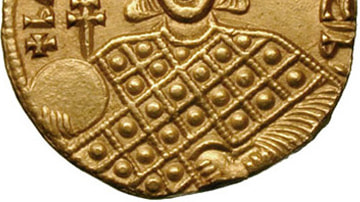
Basil I
Basil I was emperor of the Byzantine Empire from 867 to 886 CE and he founded the "Macedonian" dynasty which lasted for over 200 years. Basil was an Armenian from a humble background who had risen to become the second most powerful man...
Definition
Sallust
Gaius Sallustius Crispus (86-35 BCE), better known as Sallust, was a Roman statesman and historian. He turned away from an unsuccessful career in both politics and the Roman army, choosing instead on a writing career and produced three...
