
Search
Remove Ads
Advertisement
Search Results

Video
The Law Code Stele of King Hammurabi
The Law Code Stele of King Hammurabi, 1792-1750 B.C.E., basalt, 225 x 65 cm (Louvre, Paris). Speakers: Dr. Steven Zucker and Dr. Beth Harris

Definition
Mesopotamian Government - Helping and Serving the Gods
Ancient Mesopotamian government was based on the understanding that human beings were created to help and serve the gods. The high priest, king, assembly of elders, governors, and any other officials...

Definition
Ur-Nammu - Founder of the Sumerian Renaissance
Ur-Nammu (circa 2112-2094 BCE) was the founder of the Third Dynasty of Ur in Sumer, who initiated the so-called Ur III period (circa 2112 to circa 2004 BCE), also known as the Sumerian Renaissance. He is...
Image
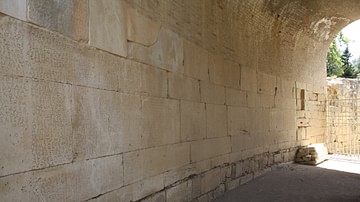
The Law Code of Gortyn, Crete
The lawcode from Gortyn, Crete was written in the 5th century BCE and is said to be the largest epigraphic text in ancient Greek (8 m x 1.70 m).
Image
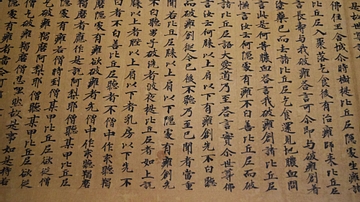
Portion of a Japanese Monastic Code of Conduct
This is a selection from the "Gogatsu tsuitachi kyo" compilation, vol. 39, and it details the rules and regulations for monks in ancient Japan. It dates from 740 CE, which corresponds to the Nara period...

Video
The Plague of Justinian
In 540 CE, Eastern Roman Emperor Justinian I had great ambition of regaining Western Roman territories. His goal was to restore the Eastern Roman empire to what it was before the Roman empire dissolved. However, just a year...

Image
Justinian I
Detail of a contemporary portrait of Justinian I in the Basilica of San Vitale, Ravenna. The emperor's robe is of Tyrian purple.
Image
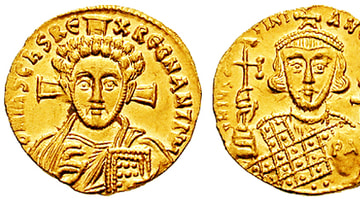
Coin of Justinian II
A gold coin of Byzantine emperor Justinian II (r. 685-95 & 705-11 CE). This example is from his second reign. (Classical Numismatic Group, Inc. http://www.cngcoins.com)
Image
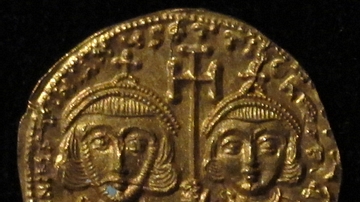
Justinian II & Tiberius
A gold coin depicting Byzantine emperor Justinian II (r. 685-95 & 705-11 CE) and his son Tiberius (d. 711 CE).

Image
Emperor Justinian & His Court
A 6th century CE mosaic depicting Emperor Justinian and his court in the Basilica of San Vitale in Ravenna.
