
Search
Remove Ads
Advertisement
Search Results

Image
The Law Code of Gortyn, Crete
The lawcode from Gortyn, Crete was written in the 5th century BCE and is said to be the largest epigraphic text in ancient Greek (8 m x 1.70 m).
Image
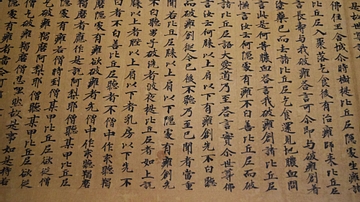
Portion of a Japanese Monastic Code of Conduct
This is a selection from the "Gogatsu tsuitachi kyo" compilation, vol. 39, and it details the rules and regulations for monks in ancient Japan. It dates from 740 CE, which corresponds to the Nara period...

Definition
French Consulate
The French Consulate was the government of the First French Republic from 10 November 1799 to 18 May 1804, spanning the last four years of the Republic's existence. Headed by Napoleon Bonaparte (1769-1821) as First Consul, the...

Video
The Plague of Justinian
In 540 CE, Eastern Roman Emperor Justinian I had great ambition of regaining Western Roman territories. His goal was to restore the Eastern Roman empire to what it was before the Roman empire dissolved. However, just a year...

Article
Ten Ancient Mesopotamia Facts You Need to Know - Fun Facts on the Cradle of Civilization
Mesopotamia is the ancient Greek name (meaning "the land between two rivers," the Tigris and Euphrates) for the region corresponding to modern-day Iraq and parts of Iran...

Video
The Code of Ur-Nammu (Full Text)
The Code of Ur-Nammu is the oldest surviving code of laws. Written in Sumerian in cuneiform and dating from around 2100 BC, what remains of the code of laws gives us an insight into Mesopotamian life around fifty...

Definition
Electrical Telegraph
The electrical telegraph was invented in 1837 by William Fothergill Cook (1806-1879) and Charles Wheatstone (1802-1875) in England with parallel innovations being made by Samuel Morse (1791-1872) in the United States. The...

Video
Plague of Justinian & Yersinia pestis
Genomic analysis has shown that the plague of Justinian and the Black Death were caused by distinct strains of the same pathogen. Dr. Hendrik Poinar discusses the findings.Video copyright: McMaster University
Article
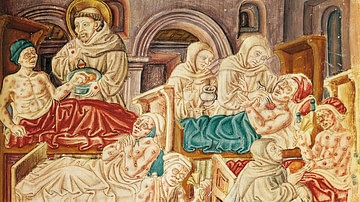
Reactions to Plague in the Ancient & Medieval World
Throughout history, epidemics and pandemics of plague and other diseases have caused widespread panic and social disorder even, in some instances, when the people of one region were aware of a pervasive...

Definition
Byzantine Empire
The Byzantine Empire existed from 330 to 1453. It is often called the Eastern Roman Empire or simply Byzantium. The Byzantine capital was founded at Constantinople by Constantine I (r. 306-337). The Byzantine Empire varied in...
