
Search
Remove Ads
Advertisement
Search Results

Definition
Byzantine Architecture
The architecture of the Byzantine Empire (4th - 15th century CE) continued its early Roman traditions but architects also added new structures to their already formidable repertoire, notably improved fortification walls and...

Definition
Western Roman Empire
The Western Roman Empire is the modern-day term for the western half of the Roman Empire after it was divided in two by the emperor Diocletian (r. 284-305 CE) in c. 285/286 CE. The Romans themselves did not use this term...

Definition
Antonine Plague
The Antonine Plague, sometimes referred to as the Plague of Galen, erupted in 165 CE, at the height of Roman power throughout the Mediterranean world during the reign of the last of the Five Good Emperors, Marcus Aurelius Antoninus...

Article
Women in the Byzantine Empire
Women in the Byzantine Empire (4th to 15th century CE) were, amongst the upper classes, largely expected to supervise the family home and raise children while those who had to work for a living did so in most of the...

Article
Byzantine Icons
Icons, that is images of holy persons, were an important part of the Byzantine Christian Church from the 3rd century CE onwards. Venerated in churches, public places, and private homes, they were often believed to have protective...

Definition
Leo VI
Leo VI was emperor of the Byzantine empire from 886-912 CE. He was the second emperor of the Macedonian dynasty and is sometimes known as “Leo the Wise” in reference to his prolific literary output which ranged from orations to law codes...

Definition
Cilicia Campestris
Cilicia Campestris was one of the six districts of the Roman province of Cilicia organized by Pompey the Great (l. c. 106-48 BCE) in 64 BCE. The name translates roughly into “Cilicia of the Plains” and corresponds to the earlier...

Definition
Quaestor
The quaestor ("the one who asks questions") was the oldest and lowest office on the cursus honorum, or "path of honor" in ancient Rome. Considered a stepping stone to higher office in the Roman government, the duties of the quaestor...

Definition
Matilda of Tuscany
Matilda of Canossa (c. 1046-1115), the Countess of Tuscany (r. 1055-1115) and Vice-Queen of Italy (r. 1111-1115), was the final head of the noble House of Canossa following the deaths of her father in 1052 and her elder brother...
Image
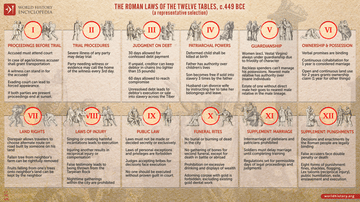
The Roman Laws of the Twelve Tables, c. 449 BCE
The Laws of the Twelve Tables (c. 451–450 BCE) represent the earliest surviving codification of Roman law during the early Roman Republic (traditionally founded 509 BCE). Drafted by a special commission...
