
Search
Remove Ads
Advertisement
Search Results

Definition
Voltaire
Voltaire (1694-1778) was a French author, historian, and philosopher whose thoughts on religious toleration and moderation of authoritarian power were influential during the Enlightenment. His most famous work today is the satirical...

Definition
Denis Diderot
Denis Diderot (1713-1784) was a French author and philosopher known for his views which influenced the Enlightenment and his general editorship of the multi-volume Encyclopedia, often described as the 'Bible of the Enlightenment'...

Definition
Night of the Long Knives
The Night of the Long Knives (aka Blood Purge or Röhm-Putsch) of 30 June 1934 was a purge of the Nazi Sturmabteilung (SA) paramilitary group which continued through 1 and 2 July. Adolf Hitler (1889-1945), wary of the growing...

Definition
Johannes Hevelius
Johannes Hevelius (1611-1687) was a Polish astronomer based in Danzig (Gdańsk). He worked from his own privately funded observatory, creating maps of the Moon's surface, discovering the first variable star, and spotting several...

Definition
Book of Job
The book of Job in the Hebrew Bible is found among the books designated Ketuvim ("writings"), along with Ecclesiastes and the Book of Proverbs. All three belong to a genre known as wisdom literature. The books share a common ancient...

Definition
Richard Wagner
Richard Wagner (1813-1883) was a German composer of Romantic music most famous for his epic operas like The Ring, Tannhäuser, and Tristan and Isolde. Wagner was concerned throughout his career with the theme of redemption through...

Definition
George Berkeley
George Berkeley (1685-1753) was an Anglo-Irish bishop and an empiricist and idealist philosopher. He infamously claimed that no matter exists outside of God and that things only exist outside of our minds and perceptions because...

Article
The Printing Press & the Protestant Reformation
The printing press, credited to the German inventor and printer Johannes Gutenberg (l. c. 1398-1468) in the 1450s, became the single most important factor in the success of the Protestant Reformation by...
Article
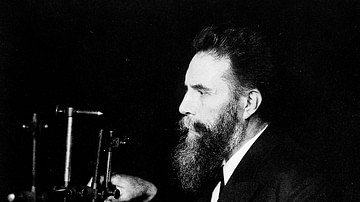
Discovery of X-Rays
The discovery of X-rays – a form of invisible radiation that can pass through objects, including human tissue – revolutionised science and medicine in the late 19th century. Wilhelm Conrad Röntgen (1845-1923), a German scientist...

Article
Battle of Trenton
The Battle of Trenton (26 December 1776) was an important battle of the American Revolutionary War (1775-1783). On Christmas Day 1776, General George Washington led his Continental Army across the Delaware River to launch a surprise...
