
Search
Remove Ads
Advertisement
Search Results

Definition
Leo Africanus
Leo Africanus (al-Hasan ibn Muhammad ibn Ahmad al-Wazzan al-Fasi al-Granati, 1485-1554) was a diplomat, merchant traveller and scholar who famously voyaged from Timbuktu to the Niger River and wrote 'The Description of Africa' (La...

Definition
Frédéric Chopin
Frédéric Chopin (1810-1849) was a Polish composer and virtuoso noted for his solo piano music. Chopin's work helped make the piano the most popular musical instrument of the 19th century. One of the great composers of Romantic...

Definition
Thomas Müntzer
Thomas Müntzer (l. c. 1489-1525) was a German theologian and apocalyptic preacher who became one of the leaders of the German Peasants' War (1524-1525). An early follower of the reformer Martin Luther (l. 1483-1546), Müntzer established...

Definition
Augsburg Confession
The Augsburg Confession is the affirmation of faith of the Lutheran Church written by Philip Melanchthon (l. 1497-1560) and presented at the Diet of Augsburg in June 1530. The document attempted to reconcile differences between...

Definition
Gustav Mahler
Gustav Mahler (1860-1911) was an Austrian-Bohemian composer best known for his song-cycles and his grand, sweeping symphonies, which often require expanded orchestras for their full performance. Mahler, a composer of Late-Romantic...

Definition
Andreas Karlstadt
Andreas Karlstadt (also given as Carlstadt, l. 1486-1541) was a reformer, theologian, and early supporter of Martin Luther (l. 1483-1546) in the movement that became known as the Protestant Reformation. Karlstadt was one of Luther's...
Definition
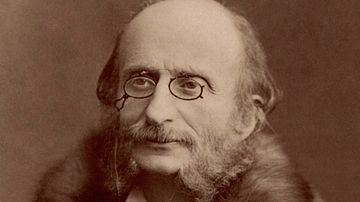
Jacques Offenbach
Jacques Offenbach (1819-1880) was a composer of German birth who took French citizenship and became famous in Paris for his comic operettas, a genre he created, and for the more serious opera, The Tales of Hoffmann. A virtuoso...

Definition
The Enlightenment
The Enlightenment (Age of Reason) was a revolution in thought in Europe and North America from the late 17th century to the late 18th century. The Enlightenment involved new approaches in philosophy, science, and politics. Above...

Definition
Isaac Newton
Isaac Newton (1642-1727) was an English mathematician and physicist widely regarded as the single most important figure in the Scientific Revolution for his three laws of motion and universal law of gravity. Newton's laws became...

Definition
Thomas Hobbes
Thomas Hobbes (1588-1679) was an English philosopher who famously summarised his pessimistic view of human nature in his greatest work, Leviathan, published in 1651. Hobbes believed that the life of humanity in the state of nature...
