
Search
Remove Ads
Advertisement
Search Results

Article
Tea in Ancient China & Japan
Tea, still probably the world's most popular prepared beverage, was first drunk by Chinese monks to aid meditation and those who valued its medicinal qualities, but it quickly grew in popularity, spreading to other East...

Video
Japanese Art History: Asuka & Nara Periods
The Impact of China and Buddhism on Japanese art during the Asuka and Nara Periods.

Definition
Menehune
Menehune is the term applied to short-statured, forest-dwelling creatures of Hawaiian mythology and is part of a common mythology throughout Polynesia that describes secretive, supernatural beings with human-like attributes. Mysterious...

Definition
Prince Shotoku
Prince Shotoku (574-622 CE) ruled as regent of Japan from 594 to 622 CE and is one of the most celebrated figures in all of Japanese history. The prince was a great supporter of Chinese culture and Buddhism, spreading both during...

Definition
Emperor of Japan
The emperor of Japan is a position as the head of state which traditionally dates back to the 7th century BCE and the legendary figure of Emperor Jimmu (r. 660-585 BCE). Emperors came to be known as the Tenno or 'heavenly sovereign'...

Definition
Noh Theatre
Noh (Nō) theatre is a Japanese performance art which became especially popular from the 14th century CE and which is still performed today. Noh actors, who were always male in the medieval period, famously move and make gestures in...

Definition
Oda Nobunaga
Oda Nobunaga was the foremost military leader of Japan from 1568 to 1582. Nobunaga, along with his two immediate successors, Toyotomi Hideyoshi (1537-1598) and Tokugawa Ieyasu (1543-1616), is credited with unifying medieval Japan...

Definition
Chushingura
Kanadehon Chushingura (A Treasury of Loyalty of Loyal Retainers or The Story of the Forty-Seven Samurai) is the most popular play in the history of Japanese theatre, first performed in 1748. It is a work of fiction, but the details...
Definition
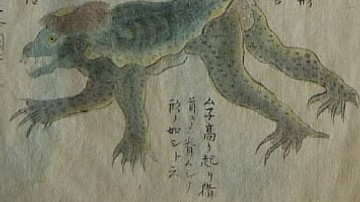
Kappa
A kappa is a Japanese mythological water sprite or, literally, "river child" (河童). One of the more popularly known yōkai (Japanese mythological creature) in Japan, kappa are generally green or yellow, have a tortoise-like shell on their...

Video
Japanese Art History: Jomon, Yayoi and Kofun Periods
The art of Neolithic Jomon and the Protohistoric Yayoi and Kofun periods of Japan.
