
Search
Did you mean: Iris?
Remove Ads
Advertisement
Search Results

Image
Lion-Hunting Scene, King Ashurbanipal
Sculpted relief illustrating the sporting exploits of the last great Assyrian king, Ashurbanipal, North Palace, room C, panel 20-22, Nineveh, modern-day northern Iraq. Neo-Assyrian Empire, reign of King Ashurbanipal...

Image
Map of the World from Sippar, Mesopotamia
This tablet contains both a cuneiform inscription and a unique map of the Mesopotamian world. Babylon is shown in the center (the rectangle in the top half of the circle), and Assyria, Elam and other places...

Image
The Ziggurat at Kish
Ruins of the ziggurat at the ancient Sumerian city of Kish, probably built by the neo-Babylonian king Nebuchadnezzar II, in the 6th century BCE.
Tell al-Uhaymir, Babil Governorate, Iraq.
Image
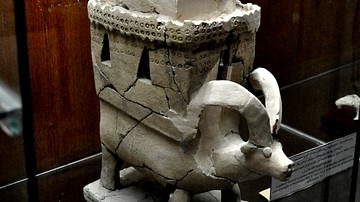
Mesopotamian Incense Container
A pottery incense container found at layer 5 of the altar platform of the central temple of Basmosian Hill, Mesopotamia, Hurrian period, 2nd millennium BCE.
Sulaimaniya Museum, Iraq.

Image
Sumerian Worshipper Statue
A statue of a Sumerian worshipper. Marble, early dynastic period, 2800-2300 BCE, Mesopotamia, Sulaimaniya Museum, Iraq.
Image
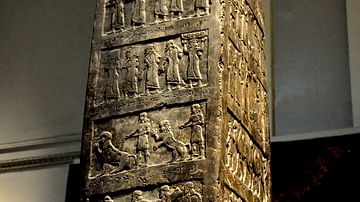
The Black Obelisk of King Shalmaneser III
This obelisk was erected as a public monument in 825 BCE at a time of civil war. The relief sculptures glorify the achievements of King Shalmaneser III and his commander-in-chief . It lists their military campaigns...

Image
Stela of King Shamshi-Adad V
Stela of the Assyrian king Shamshi-Adad V (r. 824-811 BCE), from Nimrud (ancient Kalhu), modern-day northern Iraq, Neo-Assyrian Empire, 824-811 BCE. It depicts the king, before the symbols of his principal gods. He...

Image
Ruins of the Ziggurat and Temple of Nabu at Borsippa
The so-called "tongue tower" at the top of the ruins of the ziggurat and temple of Nabu, at the ancient city of Borsippa, built in the 6th century BCE.
Biris Namrud, Babil Governorate, Iraq.

Image
Lamassu from Ashurnasirpal II Palace
This is a pair of guardian figures (winged human-headed lions) that flanked one of the entrances into the throne room of Ashurnasirpal II (883-859 BCE). Stone mythological guardians, sculpted in relief or in the...

Image
Head of Lamassu from Ashurnasirpal II palace
A close-up view of a winged human-headed lion, Lamassu, that flanked one of the entrances into the throne room of Ashurnasirpal II (883-859 BCE). Nimrud (ancient Kalhu), north-west palace, room B, door a...
