
Search
Remove Ads
Advertisement
Search Results

Definition
Pax Mongolica - Trade and Cultural Exchange in the Mongol Empire
The Mongol Empire was the largest land empire in world history, at about 22,000,000 square kilometers (850,000 square miles). The term Pax Mongolica (Mongol Peace) refers to the way this massive...

Definition
Tarascan Civilization
The Tarascan civilization (aka the Purépecha, after their language) dominated western Mexico and built an empire that would bring it into direct conflict with that other great Mesoamerican civilization of the Post-classic...

Definition
Montesquieu
Montesquieu (1689-1757) was a French philosopher whose ideas in works like The Spirit of the Laws helped launch the Enlightenment movement in Europe. His ideas on the separation of powers, that is, between the executive, legislative...
Definition
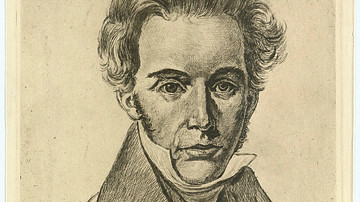
Søren Kierkegaard
Søren Kierkegaard (1813-1855) was a Danish philosopher and is considered to be the first existentialist, influencing such notable philosophers as Jean-Paul Sartre (1905-1980) and Martin Heidegger (1889-1976). His works are a...

Definition
Antinous
Antinous (l. c. 110-130 CE) was a youth of Bithynia who became the beloved of the Roman emperor Hadrian (l. 76-138 CE, r. 117-138 CE) from around the age of 13 until his death at nearly 20. His year of birth is unknown as are any details...

Definition
Charles II of England
Charles II of England (r. 1660-1685) was the king of Scotland (1649-1685) before the Restoration in 1660 also made him king of England and Ireland. Charles was a charming and easygoing monarch who took a keen interest in sports...

Definition
Mesopotamian Science and Technology - Scientific Method in the Ancient Near East
Mesopotamian science and technology developed during the Uruk period (circa 4000-3100 BCE) and the Early Dynastic period (circa 2900-2350/2334 BCE) of the Sumerian culture of...
Definition
Orontid Dynasty
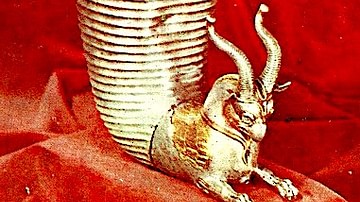
The Orontid dynasty (aka Eruandid or Yervanduni) succeeded the Kingdom of Urartu in ancient Armenia and ruled from the 6th to 3rd century BCE. Initially, the Orontids ruled as Persian satraps and the culture, language and political...

Definition
Bastet
Bastet is the Egyptian goddess of the home, domesticity, women's secrets, cats, fertility, and childbirth. She protected the home from evil spirits and disease, especially diseases associated with women and children. As with many deities...

Definition
Izanami and Izanagi
Izanami ('she who invites') and Izanagi ('he who invites') are the primordial gods of the Shinto religion who are believed to have created the islands of Japan and given birth to many of the other Shinto gods or kami. The...
