
Search
Remove Ads
Advertisement
Search Results

Definition
Gunpowder Plot - Guy Fawkes & the Plan to Blow up Parliament
The 1605 Gunpowder Plot was a failed attempt by pro-Catholic conspirators to blow up the English Parliament on 5 November and kill King James I of England (r. 1603-1625) and the entire nobility...

Definition
The Vedas
The Vedas are the religious texts which inform the religion of Hinduism (also known as Sanatan Dharma meaning “Eternal Order” or “Eternal Path”). The term veda means “knowledge” in that they are thought to contain the fundamental knowledge...
Definition
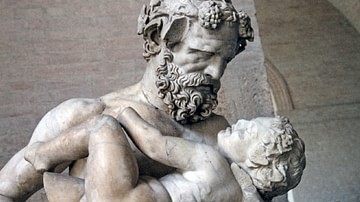
Zagreus
In ancient Greek mythology, Zagreus is a god closely associated with the wine god Dionysus, the underworld, and hunting. A son of Zeus and Persephone, he is known in the Orphic tradition as the first incarnation of Dionysus, whilst other...

Definition
Civil Constitution of the Clergy
The Civil Constitution of the Clergy was a law passed in July 1790 during the French Revolution (1789-1799), which caused the immediate subordination of the Catholic Church in France to the French government. An attempt...

Definition
Ancient China
Ancient China produced what has become the oldest extant culture in the world. The name 'China' comes from the Sanskrit Cina (derived from the name of the Chinese Qin Dynasty, pronounced 'Chin') which was translated as 'Cin' by...

Definition
Eris
Eris is the Greek goddess and personification of discord and strife. She is an unpopular figure in Greek mythology due to her problematic behaviour and her ability to stir up trouble wherever she goes. Eris is most famous for her Golden...

Definition
Elam - The Ancient High Country
Elam was a region in the Near East corresponding to the modern-day provinces of Ilam and Khuzestan in southern Iran (though it also included part of modern-day southern Iraq) whose civilization spanned thousands of...

Definition
Vardhamana
Vardhamana (l. c. 599-527 BCE), better known as Mahavira (“Great Hero”) is the sage credited with founding of the nontheistic religion of Jainism, a belief system established in the 6th and 5th centuries BCE in India, which provided...

Definition
Empedocles
Empedocles (l. c. 484-424 BCE) was a Greek philosopher and mystic whose work harmonized the philosophies of Parmenides (l. c. 485 BCE), Heraclitus (l. c. 500 BCE), and Pythagoras (l. c. 571 to c. 497 BCE) in presenting a unified vision...

Definition
Kachina Cult
The Kachina (also “Katsina”) cult refers to the specific religious practices centered on the kachina, which is a spiritual entity and divine messenger of the Puebloan peoples as well as the Hopi, Zuni, Tewa, and Keresan tribes in...
